
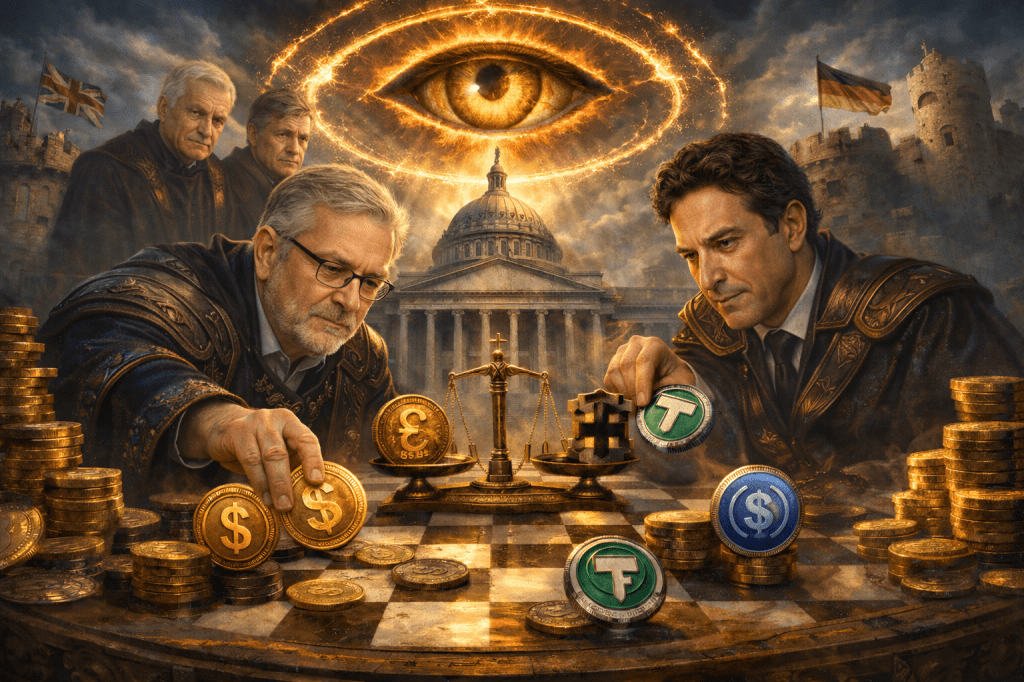
This piece draws together ideas emerging from recent conversations with some of the most compelling monetary thinkers around — most prominently Brent Johnson and Michael Every. What I find particularly striking is that the USD stablecoin thesis explored here isn’t confined to one corner of the ideological map. Thinkers like Yanis Varoufakis, coming from a very different direction, are arriving at similar conclusions. When analysts who agree on little else start converging on the same dynamic, it seems worth paying close attention.
London, September 16, 1992
The morning opened unremarkably enough. Currency traders across London’s financial district settled into their desks with coffee and newspapers, preparing for another day of managing the European Exchange Rate Mechanism. Few suspected they were about to witness one of the most audacious financial attacks in modern history.
Across the Atlantic in a modest Midtown Manhattan office, George Soros and his lieutenant Stanley Druckenmiller were about to unleash something unprecedented. For months, they’d been building a position against the British pound—$1.5 billion in shorts, betting that the UK’s ERM peg was unsustainable.[3] Britain had entered the mechanism at 2.95 deutschmarks per pound,[1] but the fundamentals told a different story. UK inflation ran triple the German rate.[2] Interest rates, already punishing for British businesses and homeowners, would need to go higher still to defend the peg. Meanwhile, Germany—reunified and hungry for capital—was the gravitational center pulling everything toward higher rates.
The system was mechanically doomed. But what transformed this insight into legend was the ruthlessness of the execution.
On the evening of September 15, Bundesbank President Helmut Schlesinger gave an interview suggesting “one or two currencies could come under pressure.”[4] The next morning, Druckenmiller reported the news to Soros.[49] Their position was already profitable, but Soros saw something more: not just an opportunity, but a kill shot.
“Go for the jugular,” Soros said.[5]
By 9:00 AM, the Quantum Fund had increased their short position from $1.5 billion to $10 billion—borrowing and selling pounds from anyone who would deal with them.[6] Other hedge funds, recognizing genius when they saw it, piled in behind.[51] The Bank of England, bound by ERM rules to accept any offers to sell pounds during trading hours, found itself in an impossible position. They bought £300 million twice before 8:30 AM.[7] Then billions more throughout the day. They raised interest rates from 10% to 12%, then to 15% in a desperate afternoon gambit.[8]
None of it mattered. The market’s perception that the pound was overvalued had become self-fulfilling reality. By 7:30 PM, Chancellor Norman Lamont announced Britain’s withdrawal from the ERM.[9] The pound fell 15% against the mark, 25% against the dollar.[10] The UK Treasury’s estimated cost: £3.3 billion.[11] Soros’s profit: over £1 billion in a single day.[12]
But this was never just about profit. It was about power. And it was about what Soros had already identified eight years earlier as the “Imperial Circle.”
The Imperial Circle: A Self-Reinforcing Mechanism
In 1984, George Soros published an essay describing the Reagan administration’s economic dynamics.[13] He called it the “Imperial Circle”—not as a moral judgment, but as a mechanical description of a self-reinforcing process that was both “beneficial for the U.S.” and “a vicious circle” for debtor nations.[14]
The mechanism was elegant in its simplicity. High budget deficits stimulated the U.S. economy. Those deficits, combined with tight monetary policy, kept interest rates elevated. High rates attracted capital from around the world. Foreign capital inflows strengthened the dollar. A strong dollar sucked in imports, creating trade deficits. Trade deficits combined with a high exchange rate moderated domestic inflation.[15][16] The result was what Soros described as “the best of all possible worlds: strong economic growth combined with low inflation and budget deficit financed by the influx of foreign goods and foreign capital.”[14]
For the United States, this was a benign, self-reinforcing circle. For peripheral nations—particularly emerging market dollar borrowers—it was a vice that “squeezed them dry.”[14] They faced the double burden of both higher dollar interest rates and a stronger dollar, making debt service progressively more painful.
The Imperial Circle was, Soros understood, inherently unstable. Eventually, confidence would crack. Foreign capital would flee. The strong dollar would reverse. And “with foreign capital seeking refuge elsewhere even a shrinking budget deficit will be more difficult to finance.”[17]
The 1992 attack on the pound was the Imperial Circle thesis in action. Germany—with its massive reunification capital requirements and consequently high interest rates—occupied the center. The UK—with an artificially pegged currency and incompatible domestic economic conditions—was a vulnerable peripheral player. All that was needed was someone ruthless enough to attack the seam.[49][50]
Scott Bessent, then working in Soros’s London office, was part of the team that executed the trade.[19][20][21] Thirty-three years later, he’s the U.S. Treasury Secretary.[22] Stanley Druckenmiller, who called the play, now runs the Duquesne Family Office.[23] Kevin Warsh, confirmed as the next Fed Chairman,[26] has been Druckenmiller’s partner at Duquesne since 2011.[24][25]
The band is back together.
Which raises an uncomfortable question: Is the U.S. positioning for a global Imperial Circle play—this time using dollar stablecoins as the primary mechanism?
Triffin’s Long Shadow
The Imperial Circle concept maps directly onto the structural contradictions I described in my previous essay on Triffin’s Dilemma.[18] The dollar’s role as global reserve currency creates persistent, mechanical imbalances. The U.S. must run deficits to supply the world with dollars. Those deficits eventually undermine confidence in the system they sustain. Each adaptation—from Bretton Woods to the eurodollar to the petrodollar—has prolonged the system while deepening the underlying instability.
We now face a moment where multiple pressures converge. The U.S. holds nearly $40 trillion in national debt,[40] with annual interest expenses exceeding $1 trillion—now the second-largest line item in the federal budget.[41] The trade deficit runs around $1 trillion annually.[42] The net international investment position stands at negative $27.6 trillion.[43] Meanwhile, traditional foreign holders of U.S. debt have been steadily reducing their positions. China, Japan, and Canada collectively held 23% of outstanding Treasuries in 2011; by late 2024, that had fallen to roughly 6%.[44]
The U.S. needs buyers for its debt. Urgently.
Enter stablecoins.
The Stablecoin Solution
A stablecoin is, in theory, simple: a cryptocurrency whose value is pegged to a stable asset—most commonly the U.S. dollar. To maintain that peg, issuers hold reserves. The two largest dollar-denominated stablecoins, Tether (USDT) and Circle (USDC), collectively hold over $130 billion in U.S. Treasury bills as of early 2025.[33] The total stablecoin market sits around $250-300 billion,[31] with projections reaching $2 trillion by 2028.[32]
The passage of the GENIUS Act in July 2025 formalized the regulatory framework.[28] The Act mandates that stablecoin issuers maintain reserves on at least a one-to-one basis,[29] with U.S. Treasury debt explicitly permitted—indeed, effectively required—as the primary reserve asset.[30] This regulatory structure essentially hardwires demand for high-quality liquid collateral into the architecture of stablecoins.
Treasury Secretary Bessent has been explicit about the strategic logic: “A thriving stablecoin ecosystem will drive demand from the private sector for US Treasuries, which back stablecoins. This newfound demand could lower government borrowing costs and help rein in the national debt.”[37]
The mechanism is mechanical, not conspiratorial. As stablecoin adoption grows—particularly in emerging markets with high inflation or unreliable domestic currencies—demand for dollar-backed tokens increases. Every new stablecoin in circulation requires corresponding reserves, channeling capital into U.S. Treasuries.
Bottom-Up Dollarization
What makes stablecoins particularly powerful is their ability to enable bottom-up dollarization at scale.[47] Historically, citizens in countries with weak currencies have sought to save in dollars, but access has been constrained by capital controls and local regulations. A farmer in Argentina or a shopkeeper in Nigeria might want to hold dollars, but obtaining them and storing them securely has been difficult or impossible.
Stablecoins bypass these restrictions. Anyone with a smartphone and internet access can now hold dollar-denominated value—not as physical cash, but as a token that trades freely on digital rails, 24/7, across borders. This creates what amounts to a parallel dollar system operating outside the traditional banking infrastructure.
The geopolitical implications are profound. When citizens of other nations shift their savings into dollar stablecoins, they’re effectively voting with their capital against their domestic currency systems. This puts immense pressure on governments that rely on monetary sovereignty—particularly those that have historically financed themselves through inflation. Countries from Turkey to Venezuela have already seen significant stablecoin adoption.[46] Nigeria, despite banning crypto transactions through banks, has seen massive grassroots adoption as citizens seek to escape the naira’s persistent depreciation.[45]
From the U.S. perspective, this creates a dual advantage. First, it sustains and extends dollar hegemony in the digital age—at precisely the moment when that hegemony faces challenges from dedollarization efforts, BRICS payment systems, and the rise of the Chinese yuan. Second, it manufactures structural demand for U.S. Treasuries from an entirely new class of buyers who are less politically sensitive than foreign central banks.
The Imperial Circle, reimagined for the 21st century.
The Peripheral Squeeze
As with any Imperial Circle dynamic, the benefits to the center come at the expense of the periphery. In the Reagan-era version, emerging market dollar borrowers faced the dual squeeze of high U.S. rates and a strong dollar. The current iteration poses an even more existential threat to peripheral nations.
When citizens abandon domestic currencies in favor of dollar stablecoins, several things happen simultaneously. The government loses seigniorage revenue—the profit from issuing money. Capital flight accelerates as savings migrate offshore. The effectiveness of monetary policy erodes, since central banks can’t control money they didn’t issue. And perhaps most critically, the government’s ability to finance itself through domestic borrowing or controlled inflation collapses.
Countries facing this dynamic have limited options, none of them appealing. They can attempt to ban or restrict stablecoins, but this is increasingly difficult to enforce and drives activity underground. They can try to compete by improving their own monetary policy—difficult for countries already facing structural economic challenges. Or they can effectively surrender monetary sovereignty and accept dollarization, whether formally or informally.
The dynamic mirrors the pressure that weak-currency ERM members faced in 1992—except now it’s not just one peg being attacked, but potentially dozens of currency systems simultaneously. And the attacker isn’t a hedge fund, but market forces channeled through technology that makes capital flight frictionless.
For countries like Turkey, Argentina, Nigeria, Egypt, and Pakistan—all of which have experienced high inflation and currency instability—stablecoins represent an existential challenge to monetary sovereignty.[46] For the United States, they represent a mechanism to extend dollar dominance without needing to negotiate with foreign central banks or maintain military presences to secure petrodollar arrangements.
From Private to Programmable
If the story ended here—with private stablecoin issuers creating Treasury demand while enabling bottom-up dollarization—it would already represent a significant geopolitical development. But there are compelling reasons to believe this is not the end state.
The ultimate logic points toward greater state control. The same qualities that make stablecoins attractive for extending dollar hegemony—their digital nature, their transparency, their programmability—also make them attractive as instruments of surveillance and control.
Consider the trajectory. Right now, stablecoin transactions occur on public blockchains. They’re pseudonymous but traceable. Every transaction is recorded. Every wallet can be monitored. The infrastructure already exists to tie real-world identities to wallet addresses through KYC requirements at entry and exit points. This creates a level of financial surveillance that would be impossible with physical cash or traditional banking.
Now consider the incentives facing the U.S. government. The ability to monitor—and potentially control—a significant portion of global dollar flows in real-time is an intelligence and enforcement capability without historical precedent. The ability to program money—to set conditions on its use, to freeze accounts, to implement negative interest rates, to ensure tax compliance automatically—represents a degree of monetary control that central bankers have only dreamed of.
The path from the current system to a more controlled one likely proceeds through one of several channels. The first is regulatory capture, where the government imposes increasingly stringent requirements on private issuers—requirements around reserves, reporting, transaction monitoring, and perhaps eventually around acceptable uses. Over time, the distinction between a “private” issuer operating under heavy regulation and a quasi-governmental entity blurs.
The second path is through direct competition. The U.S. could issue its own stablecoin or Central Bank Digital Currency (CBDC), offering advantages that private issuers cannot match—perhaps FDIC insurance, direct convertibility to Federal Reserve accounts, or tax advantages. Once established, private competitors could be marginalized or prohibited.
The third path is through nationalization. If stablecoins become systemic—if they represent trillions of dollars in circulation and fund a significant portion of Treasury debt—the government gains leverage to intervene directly. A crisis—real or engineered—could provide the pretext. “Too important to fail” becomes “too important to remain private.”
None of these paths require conspiracy. They follow from the internal logic of state power and the particular affordances of programmable money. A government that gains the ability to monitor and control digital money flows will eventually use that ability. The question is not whether, but when and how extensively.
The End Game: Surveillance as Money
The vision that emerges is one where money itself becomes a mechanism of social control. A fully digital, programmable dollar system allows for capabilities that would have seemed dystopian a generation ago but now appear merely inevitable.
Every transaction monitored. Every expenditure categorized. Tax compliance automated. “Unacceptable” purchases blocked in real-time. Negative interest rates on savings implemented with the flip of a switch. Expiration dates on currency to prevent hoarding. Geographic restrictions on spending. Social credit scores that affect borrowing costs. Perhaps, eventually, programmable incentives: spend on approved categories, earn benefits; spend on discouraged categories, pay penalties.
The technology to implement all of this exists today. The regulatory infrastructure is being built through the GENIUS Act and similar frameworks. The geopolitical incentives align. And—perhaps most importantly—the majority of citizens will likely accept it, because the trade-offs will be presented as reasonable: convenience for privacy, security for freedom, efficiency for autonomy.
This is the deeper pattern. The Imperial Circle dynamic using stablecoins may be a relatively short-lived intermediate stage—a bridge between the current system and something more comprehensive. Private issuers demonstrate the viability of digital dollars and create demand. The state then steps in to capture both the infrastructure and the data.
The Players Are In Place
Which brings us back to where we began: with Soros, Druckenmiller, and Bessent executing the trade of the century in September 1992.
Scott Bessent sits at Treasury.[22] Kevin Warsh, Druckenmiller’s partner for over a decade,[24] is positioned to chair the Fed.[26] The intellectual framework—the Imperial Circle thesis, the understanding of how to identify peripheral vulnerabilities, the willingness to exploit structural imbalances—is shared DNA among these players.
Is this coincidental? Perhaps. But pattern recognition suggests otherwise.
The 1992 trade succeeded because the participants understood the mechanics of self-reinforcing feedback loops and had the conviction to bet massive size on structural inevitability. They saw that Germany formed a high-interest-rate core that would put unbearable pressure on peripheral currencies with incompatible fundamentals. They recognized that market perceptions, once catalyzed, become self-fulfilling. And they had the nerve to attack the seam where mechanical forces would do the work for them.[49][50]
The current setup has similar characteristics. The U.S. faces structural deficits requiring sustained Treasury demand. Stablecoins provide a mechanism to manufacture that demand while extending dollar dominance. Peripheral currencies face pressure from bottom-up dollarization. The technology infrastructure enables both Treasury funding and eventual state control. The regulatory framework is being put in place. And the key players understand the playbook.
If this is indeed an Imperial Circle 2.0 play, the peripheral vulnerabilities are already visible. Turkey, Argentina, Nigeria, Egypt, Pakistan, and dozens of other nations with weak currencies and high inflation are experiencing the early stages of stablecoin-driven dollarization.[46] Each citizen who converts savings from local currency to USDT represents a small betrayal of domestic monetary sovereignty. Aggregate enough of these individual decisions, and you get a run on the currency—not orchestrated by a hedge fund, but by millions of people acting in their own rational self-interest.
The elegant brutality of the mechanism is that it doesn’t require coordination. It’s structural. It’s mechanical. It’s gravity.
Certainty and Uncertainty
Some aspects of this trajectory seem nearly certain. Stablecoin adoption will continue to grow, particularly in countries with weak currencies. This will create sustained demand for U.S. Treasuries, providing relief for U.S. fiscal pressures. Dollar hegemony will extend into the digital realm, at least in the medium term. And some degree of increased state monitoring and control over digital money flows is inevitable.
Other aspects remain genuinely uncertain. Will private stablecoin issuers maintain independence, or will they be captured or replaced by state-issued alternatives? How quickly will the shift toward programmable money occur? Will there be meaningful resistance from privacy advocates, technologists, or competing jurisdictions? Will decentralized alternatives like Bitcoin provide a credible exit option for those who reject surveillant monetary systems?
Most fundamentally: to what extent is this trajectory being consciously orchestrated, and to what extent is it simply the emergent result of various actors responding to incentives?
My instinct, shaped by the principle of always determining the role of mechanical causality before imputing motivation, is that both are true. The structural forces are real and would operate regardless of individual intentions. But skilled players—players who understand these forces—can position themselves to benefit from structural inevitability. They can catalyze transitions that were going to happen anyway. They can ensure they’re on the right side of the gravity well when it collapses.
This was the lesson of September 16, 1992. Soros and Druckenmiller didn’t create the structural vulnerability in the UK’s ERM position. German reunification did that. Interest rate differentials did that. Incompatible fiscal and monetary policies did that. What Soros and Druckenmiller did was recognize the vulnerability, bet accordingly, and catalyze the collapse.[49]
The stablecoin trajectory follows similar logic. The structural pressures—U.S. fiscal deficits, dollar hegemony challenges, the inadequacy of legacy payment systems, the appeal of digital assets—exist independent of any individual’s plans. But players who understand these forces can position themselves to benefit from the transition.
What Does This Mean for You?
From a personal navigation perspective, the implications depend on where you sit relative to these dynamics.
If you’re a U.S. citizen with dollar-denominated assets, stablecoins in the medium term likely benefit you by sustaining demand for Treasuries, potentially lowering interest rates, and maintaining dollar purchasing power relative to other currencies. In the longer term, you face the trade-off of living in an increasingly surveillant monetary system.
If you’re in a peripheral country with a weak currency, stablecoins offer a practical escape hatch from domestic monetary mismanagement—but at the cost of contributing to your own currency’s demise and accepting dependence on a foreign monetary system with its own emerging control mechanisms.
If you value privacy and monetary freedom, the trend is unambiguous: the window for preserving financial privacy is closing. Assets held in digital systems, whether stablecoins or traditional banking, are increasingly monitored. The only near-term alternatives are physical cash (being phased out), commodities like gold (difficult to transact with), and genuinely decentralized cryptocurrencies like Bitcoin (which carry their own risks and trade-offs).
For everyone, the core question becomes: How do you position yourself for a world where money itself becomes programmable, surveillant, and potentially restrictive?
This is not, primarily, a question of politics or ideology. It’s a question of structural trajectory. The same technology that makes stablecoins possible also makes financial surveillance possible. The same connectivity that enables global dollarization also enables centralized control. The same programmability that provides convenience also enables coercion.
You cannot avoid making a choice here simply by ignoring the question. Inaction is a choice—a choice to accept whatever system emerges as default. Active positioning requires understanding the mechanics, recognizing the trajectory, and making deliberate decisions about where to hold assets, how to maintain optionality, and what trade-offs you’re willing to accept.
Gravity Wells and Adaptive Action
The broader lesson, as with Triffin’s Dilemma, is that many of the forces shaping our world behave less like human decisions and more like gravity wells. Stablecoins are not a conspiracy. They’re a technological solution to real problems—currency instability, expensive cross-border payments, Treasury funding needs. That they also serve geopolitical ends and enable surveillance is not separate from their utility; it’s intrinsic to their nature as digital, dollar-denominated value transfer mechanisms.
The Imperial Circle is not a plot. It’s a description of self-reinforcing dynamics that emerge from structural conditions. What makes players like Soros, Druckenmiller, Bessent, and Warsh consequential is not that they create these dynamics, but that they understand them well enough to position accordingly. They see the gravity well forming before others do. They bet on structural inevitability. And sometimes—as in September 1992—they catalyze the collapse that was coming anyway.
Whether the current configuration of players and incentives represents a deliberate “Imperial Circle 2.0” play or simply a confluence of individual actors responding to the same structural signals is perhaps less important than recognizing that the dynamics themselves are real. Stablecoins will create Treasury demand. They will enable bottom-up dollarization. They will extend dollar hegemony. And they will eventually be captured or displaced by state-controlled alternatives that maximize surveillance and control.
These outcomes follow from the nature of the technology, the incentives facing key actors, and the logic of state power. Understanding this allows for adaptive action.
In periods when gravity wells shift—when Bretton Woods collapses, when currencies unpeg, when monetary systems transform—few things matter more than clear sight and the willingness to act on what you see. The players from 1992 understood this. They’re positioned again.
The question is: Are you?
Footnotes
[1] UK entered ERM at 2.95 deutschmarks per pound: The United Kingdom joined the European Exchange Rate Mechanism in October 1990 at a rate of 2.95 DM per pound sterling. Sources: Wikipedia, “Black Wednesday”; IG UK, “What was Black Wednesday?”
[2] UK inflation was triple the German rate: At the time of Black Wednesday, British inflation was running at approximately three times the rate of German inflation, making the fixed exchange rate economically unsustainable. Sources: Priceonomics, “The Trade of the Century”; The Economics Review, “How Soros Broke the British Pound”
[3] Soros initially held $1.5 billion short position: By mid-September 1992, George Soros and his Quantum Fund had built a short position against sterling worth $1.5 billion. Source: Etonomics, “Black Wednesday 1992: Lessons in Disaster”; GFF Brokers, “Black Wednesday, September 16, 1992”
[4] Bundesbank President Helmut Schlesinger’s interview: On the evening of September 15, 1992, an interview with Bundesbank President Helmut Schlesinger was reported in which he suggested that “one or two currencies could come under pressure.” This comment, originally intended to be off the record, triggered the speculative attack. Sources: Wikipedia, “Black Wednesday”; Priceonomics, “The Trade of the Century”
[5] “Go for the jugular” – Soros: When Stanley Druckenmiller reported Schlesinger’s comments to George Soros on the morning of September 16, Soros’s response was “Go for the jugular,” prompting the massive expansion of their short position. Source: Etonomics, “Black Wednesday 1992”
[6] Position increased from $1.5 to $10 billion: On the morning of September 16, 1992, Soros and Druckenmiller increased their short position against the British pound from $1.5 billion to $10 billion. Sources: Priceonomics, “The Trade of the Century”; The Economics Review, “How Soros Broke the British Pound”; Currency History Hub, “Black Wednesday 1992”
[7] Bank of England bought £300 million twice before 8:30 AM: The Bank of England intervened twice before 8:30 AM on September 16, purchasing £300 million worth of sterling each time in a futile attempt to support the currency. Source: Wikipedia, “Black Wednesday”
[8] Interest rates raised from 10% to 12% to 15%: On Black Wednesday, the UK government raised interest rates from 10% to 12% in the morning, then announced a further increase to 15% at 2:15 PM in a desperate attempt to defend the pound. Sources: Wikipedia, “Black Wednesday”; Etonomics, “Black Wednesday 1992”; Currency History Hub, “Black Wednesday 1992”
[9] 7:30 PM announcement of ERM withdrawal: At 7:00 PM (some sources say 7:30 PM) on September 16, 1992, Chancellor Norman Lamont announced that the United Kingdom was suspending its membership in the European Exchange Rate Mechanism. Sources: Wikipedia, “Black Wednesday”; Progressive Economy Forum, “Black Wednesday”
[10] Pound fell 15% against the mark, 25% against the dollar: In the weeks following Black Wednesday, the pound sterling fell approximately 15% against the Deutsche Mark and 25% against the US Dollar. Sources: Wikipedia, “Black Wednesday”; Etonomics, “Black Wednesday 1992”; GFF Brokers, “Black Wednesday”
[11] UK Treasury cost of £3.3 billion: The UK Treasury estimated the cost of Black Wednesday at £3.14 billion in 1997, which was revised to £3.3 billion in 2005 following documents released under the Freedom of Information Act. Earlier estimates had ranged from £13-27 billion. Sources: Wikipedia, “Black Wednesday”; IG UK, “What was Black Wednesday?”
[12] Soros profit of over £1 billion: George Soros’s Quantum Fund made over £1 billion in profit from the Black Wednesday trade. The fund’s value increased from approximately $15 billion to $19 billion almost instantly when the pound floated, with further gains bringing total profit to at least $1.4 billion for the fund managers. Sources: Wikipedia, “Black Wednesday”; Priceonomics, “The Trade of the Century”; IG UK, “What was Black Wednesday?”
[13] Imperial Circle essay published May 1984: George Soros published his essay “The Danger of Reagan’s ‘Imperial Circle'” in the Financial Times on May 23, 1984. Sources: George Soros website, georgesoros.com; Kevin Gee Substack, “Letter #3: George Soros (1984)”; New York Fed Staff Reports, “The Dollar’s Imperial Circle”
[14] Imperial Circle defined as benign for US, vicious for periphery: Soros described the Imperial Circle as “the best of all possible worlds” for the United States—”strong economic growth combined with low inflation and budget deficit financed by the influx of foreign goods and foreign capital”—while for debtor nations it operated as “a vice which squeezes them dry.” Source: George Soros, “The Danger of Reagan’s ‘Imperial Circle'”, 1984
[15] Budget deficit stimulates economy, high rates attract capital: Soros explained the mechanism: “The budget deficit stimulates the economy. Without it, the recovery could not have been as fast and vigorous as it turned out to be. The recovery, combined with high interest rates and the influx of foreign capital, tends to keep the dollar strong.” Source: George Soros, “The Danger of Reagan’s ‘Imperial Circle'”, 1984
[16] Strong dollar + high exchange rate → trade deficit: “The recovery, combined with a high exchange rate, tends to suck in imports and create a trade deficit. The trade deficit combined with a high exchange rate tends to moderate inflation.” Source: George Soros, “The Danger of Reagan’s ‘Imperial Circle'”, 1984
[17] “When capital inflows cease…” – Soros prediction: Soros warned: “It is only a question of time before the same thing happens to the U.S. budget deficit. When capital inflows cease to exceed the new rising trade deficit, the dollar will decline and the Imperial Circle will be turned upside down. With foreign capital seeking refuge elsewhere even a shrinking budget deficit will be more difficult to finance.” Source: George Soros, “The Danger of Reagan’s ‘Imperial Circle'”, 1984
[18] New York Fed research on Imperial Circle: The Federal Reserve Bank of New York published research in December 2022 revisiting Soros’s Imperial Circle concept in the context of contemporary dollar dynamics. Source: Akinci, Ozge, et al., “The Dollar’s Imperial Circle,” Federal Reserve Bank of New York Staff Reports, December 2022
[19] Bessent hired by Soros Fund Management in 1991: Scott Bessent was hired by Soros Fund Management in 1991 and eventually became head of the London office. Source: Wikipedia, “Scott Bessent”
[20] Bessent was head of London office in September 1992: During the Black Wednesday trade in September 1992, Bessent was serving as the head of Soros Fund Management’s London office and was “a leading member of the SFM group” that profited $1 billion from the trade. Sources: Wikipedia, “Scott Bessent”; NPR, “How George Soros forced the UK to devalue the pound”
[21] Bessent’s analysis of UK housing sector and interest rate exposure: Bessent’s studies into how exposed Britain’s volatile housing sector was to interest rate moves (due to widespread use of variable rate mortgages) helped persuade Stanley Druckenmiller to put on the trade. During the climax of the trade in September 1992, it was Bessent calling for them to go further. Source: Alternative Fund Insight, “How next US Treasury Secretary once broke the Bank of England”; Sebastian Mallaby, “More Money Than God”
[22] Bessent confirmed as Treasury Secretary January 27, 2025: Scott Bessent was confirmed by the United States Senate on January 27, 2025, by a vote of 68-29, and was sworn in as the 79th U.S. Treasury Secretary. Source: Wikipedia, “Scott Bessent”
[23] Druckenmiller ran Soros’s Quantum Fund 1988-2000: Stanley Druckenmiller ran George Soros’s Quantum Fund from 1988 to 2000. Source: BloomingBit, “Wash’s former boss, Bessent’s mentor… Stanley Druckenmiller emerges as a behind-the-scenes force in the US economy”
[24] Kevin Warsh is partner at Duquesne Family Office: Kevin Warsh has been a partner of Stanley Druckenmiller at Duquesne Family Office LLC since 2011. Sources: Georgetown University McDonough School of Business faculty page; Hoover Institution profile; CBS News, “Who is Kevin Warsh”
[25] Warsh joined Duquesne Family Office in 2011: Warsh joined Duquesne Family Office shortly after stepping down from the Federal Reserve Board of Governors in 2011. Source: BloomingBit, “Wash’s former boss, Bessent’s mentor”
[26] Warsh nominated for Fed Chair: President Trump nominated Kevin Warsh to replace Jerome Powell as Federal Reserve Chair, with Powell set to step down in May 2026. Source: CBS News, “Who is Kevin Warsh, Trump’s pick to succeed Jerome Powell as Federal Reserve chair”
[27] Warsh served as Fed Governor 2006-2011: Kevin Warsh served as a member of the Board of Governors of the Federal Reserve System from 2006 until 2011. He served as the Federal Reserve’s representative to the Group of Twenty (G-20) and as the Board’s emissary to Asia’s emerging and advanced economies. Sources: Hoover Institution profile; Georgetown University profile
[28] GENIUS Act passed in July 2025: The Guiding and Establishing National Innovation for U.S. Stablecoins (GENIUS) Act became law on July 17, 2025, when President Trump signed it into law. The Senate had passed it 68-30 on June 17, 2025, and the House passed it 308-122 on July 17, 2025. Sources: Congress.gov, “Text – S.1582 – 119th Congress (2025-2026): GENIUS Act”; JAMS, “How the GENIUS Act Is Reshaping Stablecoin Regulation”
[29] GENIUS Act requires 1:1 reserve backing: The GENIUS Act requires permitted payment stablecoin issuers to maintain identifiable reserves backing outstanding payment stablecoins on an at least 1-to-1 basis. Sources: Congress.gov, “Stablecoin Legislation: An Overview of S. 1582, GENIUS Act of 2025”; Paul Hastings, “The GENIUS Act: A Comprehensive Guide to US Stablecoin Regulation”
[30] Permitted reserves include US Treasuries: The GENIUS Act limits permitted reserves to: US coins and currency (including Federal Reserve notes), funds held at insured depository institutions, short-dated Treasury bills (90 days or less), repurchase agreements backed by Treasury bills, government money market funds, central bank reserves, and other similar government-issued assets approved by regulators. Sources: Congress.gov, “Text – S.1582”; Latham & Watkins, “The GENIUS Act of 2025”
[31] Stablecoin market size of $250-300 billion: As of early 2025, the total stablecoin market was valued at approximately $250-300 billion. Source: Various market analyses
[32] Projections of $2 trillion by 2028: Market analysts project the stablecoin market will reach $2 trillion by 2028, driven by the GENIUS Act’s regulatory clarity and increased institutional adoption. Sources: Yahoo Finance, “Stablecoin Giant Tether Now Holds More US Treasuries Than South Korea and UAE”; World Economic Forum, “How will the GENIUS Act work”
[33] Tether and Circle hold over $130 billion in US Treasuries: As of Q2 2025, Tether held approximately $127 billion in US Treasury exposure ($105.5 billion direct holdings plus $21.3 billion indirectly), while Circle held $45-55 billion, for a combined total exceeding $170 billion. Sources: Tether.io, “Q2 2025 Attestation Report”; LBank, “USDT vs USDC: The Ultimate Stablecoin Showdown”
[34] Updated 2025 data – Tether’s Treasury holdings: By year-end 2025, Tether’s US Treasury holdings had grown to $122 billion in direct exposure and $141 billion including overnight reverse repurchase agreements. Source: CoinDesk, “Tether (USDT) net profits top $10 billion in 2025”
[35] Tether market cap approximately $175-186 billion: Tether’s USDT market capitalization reached approximately $175 billion by Q3 2025 and grew to over $186 billion by year-end 2025, representing approximately 60% of the total stablecoin market. Sources: Crystal Intelligence, “USDT vs USDC Q3 2025”; CoinDesk, “Tether net profits top $10 billion”; CoinLaw, “Tether Statistics 2025”
[36] Circle (USDC) market cap approximately $60-75 billion: Circle’s USDC market capitalization was approximately $60 billion in Q2 2025, grew to $73.4 billion by Q3 2025, and reached approximately $75 billion later in the year, representing about 24-25% of the stablecoin market. Sources: 36Kr, “ZhiKe: Why Is Wall Street Scrambling for This Stablecoin Stock?”; Crystal Intelligence, “USDT vs USDC Q3 2025”
[37] Treasury Secretary Bessent on stablecoins creating Treasury demand: Treasury Secretary Scott Bessent stated: “A thriving stablecoin ecosystem will drive demand from the private sector for US Treasuries, which back stablecoins. This newfound demand could lower government borrowing costs and help rein in the national debt.” Source: Various financial media reports
[38] Stablecoin transaction volumes exceeding $45 trillion annually: Annual stablecoin transaction volumes exceeded $45 trillion in 2025, surpassing traditional payment networks like Visa (approximately $14 trillion in FY 2025). Source: AlphaPoint, “Stablecoin Treasury Management for Institutions: A Definitive Guide 2026”
[39] Global stablecoin transactions totaled $33 trillion in 2025: Global stablecoin transactions totaled $33 trillion in 2025, with projections to reach $56 trillion by 2030. Source: CoinLaw, “Tether Statistics 2025”
[40] US national debt approaching $40 trillion: The total US national debt is approaching $40 trillion as of early 2026. Source: Referenced in author’s previous article on Triffin’s Dilemma
[41] Annual interest expense exceeding $1 trillion: At around $1 trillion, annual interest expense is now the second-largest line item in the US federal budget after Social Security, having surpassed both defense and Medicare spending. The Congressional Budget Office (CBO) projects that interest payments on federal debt will become the largest budget item by 2051, reaching $1.9 trillion or 8.6% of GDP. Source: Referenced in author’s previous article on Triffin’s Dilemma
[42] US trade deficit around $1 trillion annually: The annual US trade deficit is approximately $1 trillion. Source: Referenced in author’s previous article on Triffin’s Dilemma
[43] US net international investment position negative $27.6 trillion: At the end of 2025, the US had a negative net international investment position of $27.61 trillion—that is, foreigners owned $27.61 trillion more of US assets than the US owned of foreign assets. Source: Referenced in author’s previous article on Triffin’s Dilemma
[44] Foreign central banks reducing Treasury holdings: China, Japan, and Canada collectively held 23% of outstanding US Treasuries in 2011; by late 2024, that had fallen to roughly 6%. China’s exposure dropped from more than $1 trillion to $756 billion. Sources: Various financial analyses; Yahoo Finance, “Stablecoin Giant Tether Now Holds More US Treasuries”
[45] Nigeria stablecoin adoption despite ban: Nigeria, despite banning crypto transactions through banks, has seen massive grassroots adoption as citizens seek to escape the naira’s persistent depreciation. Source: General market knowledge and financial reporting
[46] Countries experiencing high stablecoin adoption: Countries like Turkey, Argentina, Venezuela, Nigeria, Egypt, and Pakistan—all experiencing high inflation and currency instability—have seen significant stablecoin adoption as citizens seek to preserve purchasing power. Source: Various financial analyses and market reports
[47] Stablecoin bottom-up dollarization: Stablecoins enable bottom-up dollarization by allowing anyone with a smartphone and internet access to hold dollar-denominated value outside traditional banking infrastructure, bypassing capital controls and local regulations. Source: Market analysis and expert commentary
[48] Bank of England spent £15 billion defending the pound: Initial estimates suggested the Bank of England spent anywhere between £13-27 billion buying pounds on Black Wednesday, but declassified Treasury papers revealed the true sum was £3.3 billion. The difference was because the BoE committed to buying foreign exchange over the following six months to avoid an immediate hit to reserves. Source: IG UK, “What was Black Wednesday?”
[49] Druckenmiller was the architect of the pound short: As Scott Bessent noted in “Inside the House of Money”: “Make no mistake about it, shorting the pound was Druckenmiller’s idea. Soros’s contribution was pushing him to take a gigantic position.” Source: Focus Distribution, “Layers of Conviction – Soros and Druckenmiller shorting the pound”
[50] Robert Johnson on risk-reward of the trade: Robert Johnson, a currency trader Soros was hiring from Bankers Trust, laid out the risk-reward: “Well, sterling is liquid, so you can always exit losing positions. The most you could lose is half a percent or so.” When Druckenmiller asked what could be gained, the potential was enormous. Source: Sebastian Mallaby, “More Money Than God”; Focus Distribution, “Layers of Conviction”
[51] Other hedge funds joined the attack: Soros and Druckenmiller weren’t the only ones betting against the pound—bank prop trading desks and macro traders like Bruce Kovner and Paul Tudor Jones were betting on the same outcome. However, none had the same scale or conviction. Source: Focus Distribution, “Layers of Conviction”
[52] Tether among largest holders of US government debt: With over $127 billion in US Treasury exposure as of Q2 2025 (and $141 billion by year-end 2025), Tether ranks among the largest holders of US government debt globally, exceeding the holdings of many countries including South Korea and the UAE. Sources: Tether.io, “Q2 2025 Attestation Report”; Yahoo Finance, “Stablecoin Giant Tether Now Holds More US Treasuries”; CoinDesk, “Tether net profits”
[53] Tether’s 2025 profitability: Tether reported $10 billion in net profit through 2025, largely from interest earned on US Treasury bill reserves. The company reported approximately $4.9 billion in net profit in Q2 2025 alone. Sources: Tether.io, “Q2 2025 Attestation Report”; CoinDesk, “Tether (USDT) net profits top $10 billion in 2025”; AlphaPoint guide
[54] Circle went public June 2025: Circle went public on the NYSE in June 2025, raising $1.05 billion at $31 per share. The stock price subsequently rose to $107, signaling deepening integration with traditional finance. Source: LBank, “USDT vs USDC: The Ultimate Stablecoin Showdown”
[55] BlackRock manages Circle Reserve Fund: BlackRock, the world’s largest asset manager, manages the Circle Reserve Fund, which holds only short-term US Treasuries and overnight repos. Source: LBank, “USDT vs USDC”
[56] IMF analysis of stablecoin Treasury holdings: The International Monetary Fund’s Crypto Assets Monitor (Q3 2025) analyzed how major stablecoins have become significant holders of US Treasuries, with USDC being 93% backed by overnight repos and US Treasuries (up from 13% in 2021). Source: IMF, “Crypto Assets Monitor Q3 2025”

 Deliberative Dad