
Prologue
One moment everything seems in order, under control, explained, understood. My actions seamlessly yield anticipated outcomes. My map seems complete, or at least, adequate. My territory seems known. Then, without warning, my world is upended, shattered. I am not where I thought I was. My map is suddenly full of holes. Unknown territory looms unexpectedly where I thought I was secure. Factors I had not accounted for have burst forth, seemingly bent on my destruction. How does one respond when calamity strikes, when the known abruptly gives way to the unknown, when order suddenly capsizes into chaos?
The question is ubiquitous and eternal because the underlying psychological reality is ubiquitous and eternal: no one is immune from the capricious and arbitrary blows of life. The answer is also ubiquitous and eternal, told and retold, distilled and purified in its mythological essence since the dawn of narrative. Our forebears long ago metaphorically unlocked the governing principle of the human psyche’s perpetual struggle with the known and the unknown, with order and chaos. The dragon, voluntarily and forthrightly confronted, can be overcome. The one who voluntarily and forthrightly confronts and defeats the dragon, gains a priceless treasure. In other words, the act of voluntarily and truthfully facing the threat of the chaotic unknown is the portal to growth, renewal and healing—to life itself.
I did not grasp this ancient pattern until well into my fourth decade. In prior years, I tried many other approaches to my metaphorical dragons: ignoring, avoiding, glossing over, and overpowering by sheer force of will. Invariably, they grew and I was diminished—at times, almost extinguished. Now I strive to look my dragons in the eye, in the teeth; to confront them at the earliest opportunity; to determine the precise nature of my own culpability for their appearance in my life (for to be a wholly blameless victim of circumstance is rare indeed); and to extract and prioritize those aspects to which my agency might most profitably be applied.
The dragon came again for me just before Christmas.
One day in the Valley of the Shadow of Death
The bright winter sun streamed into the living room through the large picture window. Like a great fish, played out and nearing the landing net, the year was spent. The exhausted calm was offset only by the boys’ anticipation of Christmas—tomorrow was Christmas Eve.
The house was still. My wife Nicole lay on the couch, basking in the holiday-induced lull in her relentless legal practice. The boys had retreated to the basement TV room for their daily dose of Octonauts.
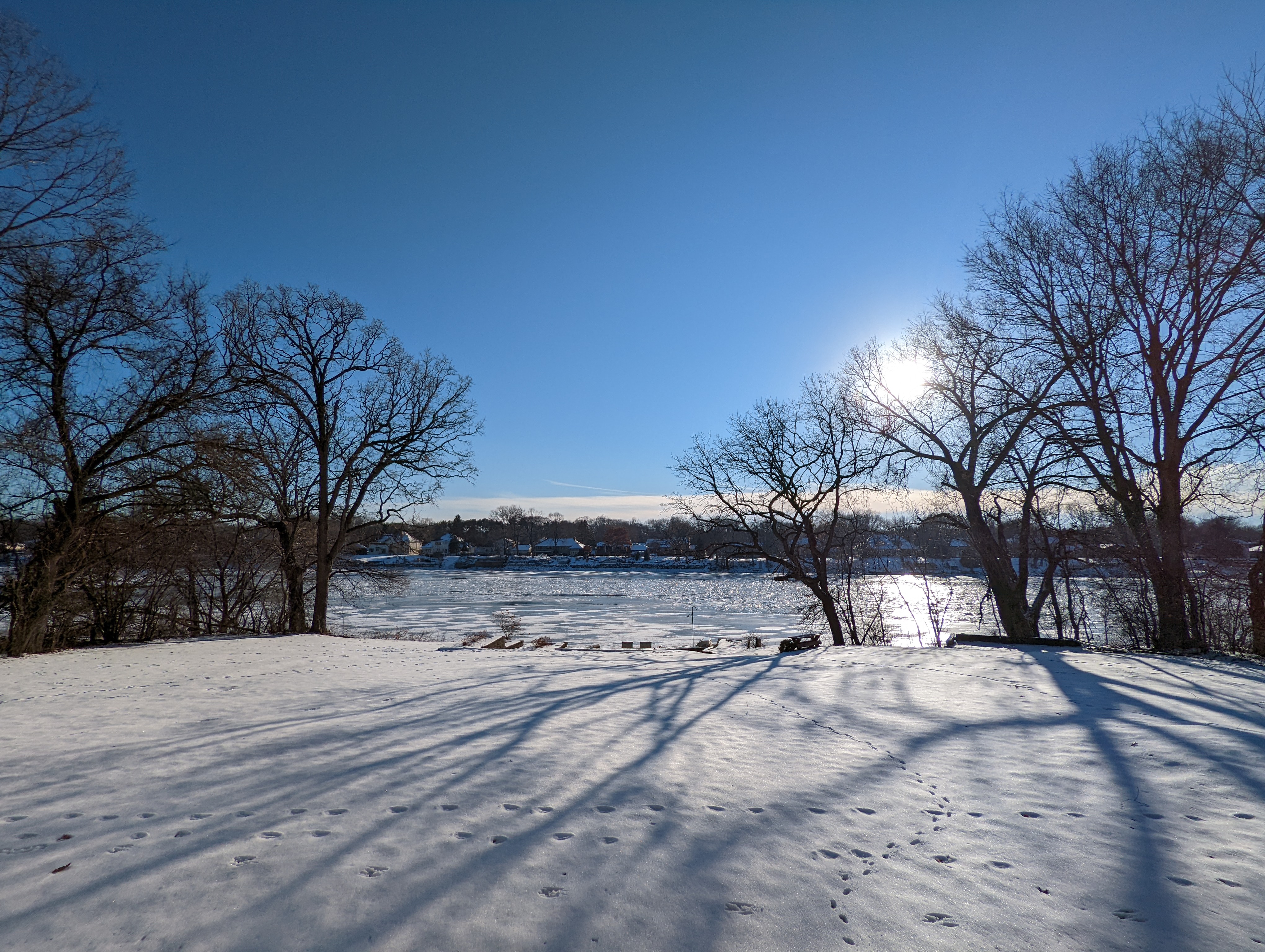
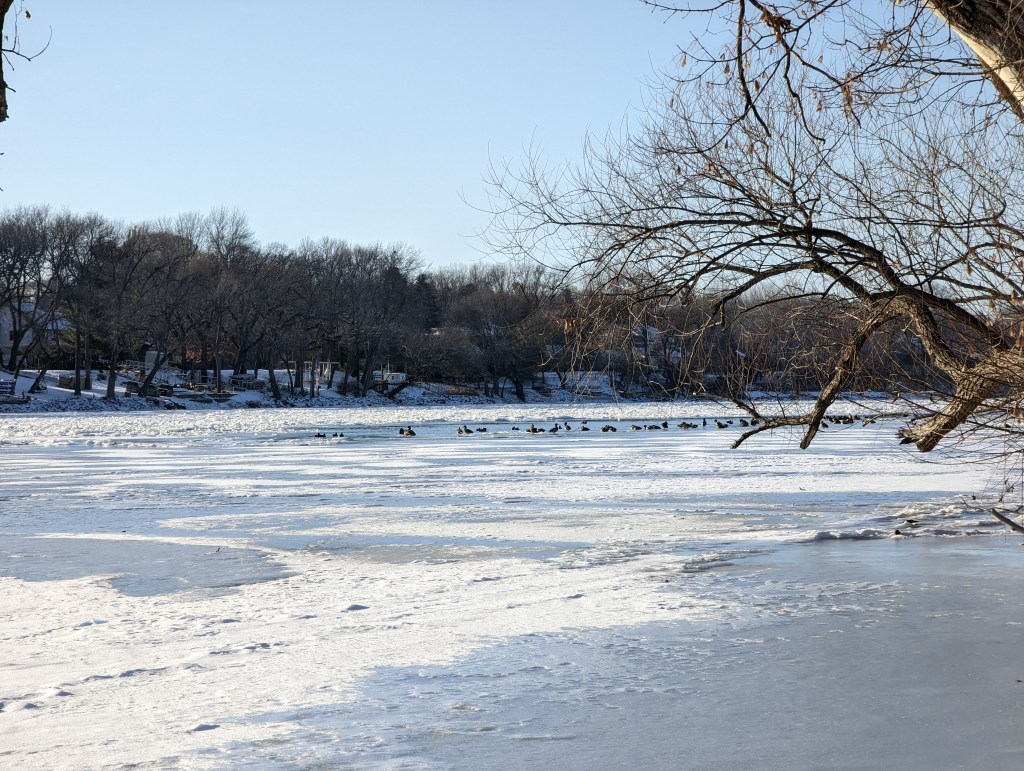
I stood, as I often do, looking out at the river. Ever changing, the dancing surface had been paused by the cold of the preceding days. Smooth ice closer to shore gave way to a jagged ice floe midstream, obscuring the steady current beneath. A pocket of open water slightly upstream to the West was dotted with mallards, seemingly determined to delay their southerly migration for yet another day.
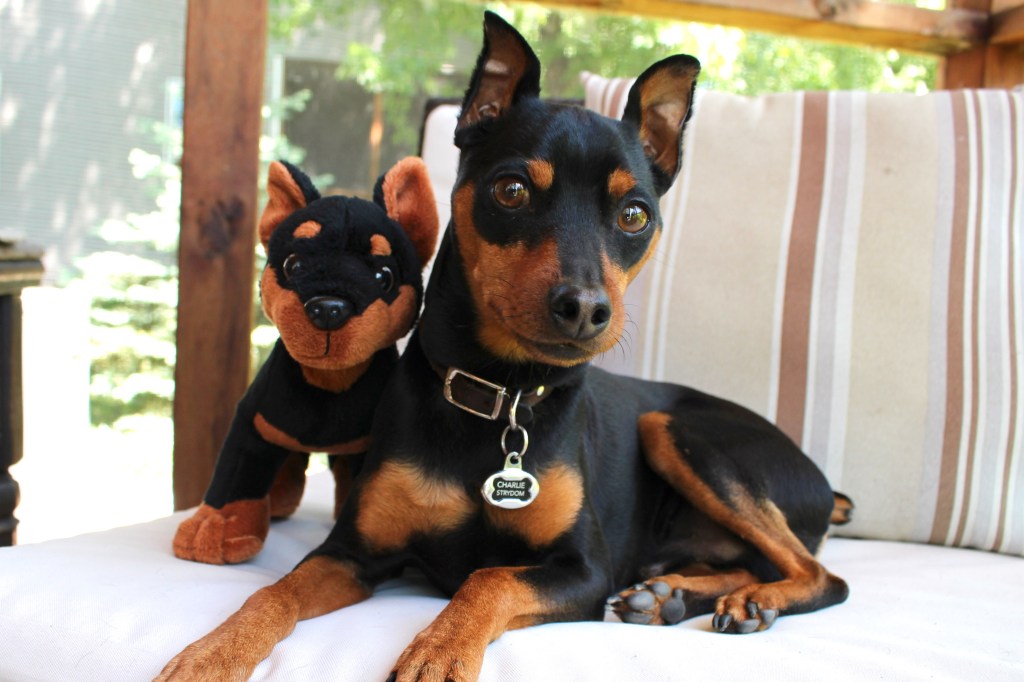
I cracked open the back door. Taking my cue, our miniature pinscher Charlie, lazily hopped off the couch. “Has Charlie been out?” I asked. “Dunno,” Nicole responded. Pushing open the screen door, I held up and steadied my phone to snap a picture (2:29 PM).
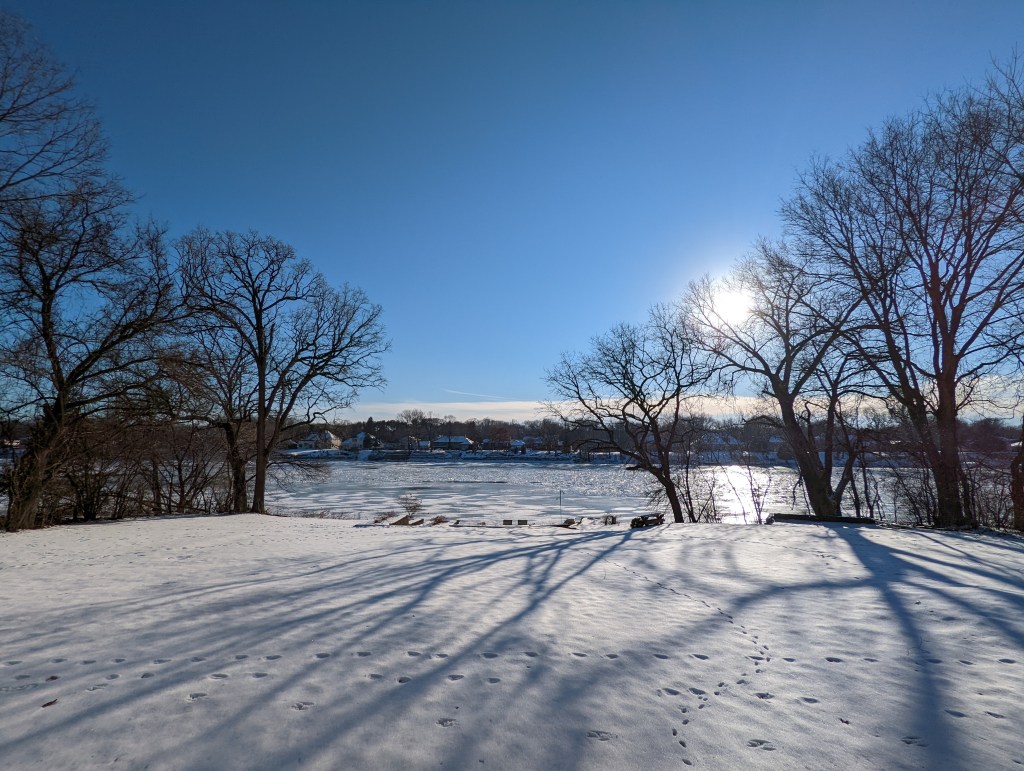
Documenting the faces of the river had become an almost daily ritual. From the moment I first laid eyes on this vista almost eleven months prior, the river had captivated me—the latest chapter in a primal relationship with bodies of water that flows like an unbroken silver rivulet from earliest memory.
Charlie slipped eagerly out the door, his quick footsteps crunching in the snow. The day was uncharacteristically warm, comfortably in the 30s. Charlie made his way down toward the end of the yard, meandered a little, then disappeared down the patio steps toward the river bank. Impervious to my repeated calls, I heard him crunching through the dry leaves and brush as he moved along the bank. Eventually he popped into view through the bare trees in the neighbor’s yard to the East. Again, I called, but—quite characteristically—to no avail. Damn it! I relented. He’ll get cold and come back soon enough. He always does.
Stepping into my Xtratuf boots, I slipped out the back door and followed Charlie’s steps. The sun felt good. Dressed in nothing but jeans and a cotton button-down shirt over a light insulating layer, I wasn’t the least bit cold.
As I approached the patio steps, I snapped another photo. The icy river was starkly beautiful today. I descended the steps to the river bank. Closer now, I watched the mallards clustered around their water hole about 75 yards upstream to the West. I steadied my phone and snapped a few more photos (2:35 PM).
Making my way back up the steps, I recalled a fall task left undone: the fridge on the patio was still running and filled with drinks from warmer days. Today seemed like the perfect opportunity to check that off my list. I hurried back inside and reemerged with a box. Back on the patio, I unloaded the contents of the fridge—ten water bottles, eight cans of Surly Furious IPA, swollen and misshapen by the cold, and a bottle of pinot grigio—a time capsule whispering of warm summer evenings, laughter and friends. I headed back into the house and unloaded the contents of the box onto the kitchen counter.
My attention turned back to Charlie. I was growing concerned. Where was he? Why couldn’t I see him? I took one of his stainless steel bowls from the kitchen cupboard. He may be impervious to being called, but the promise of food by way of the clang of his bowl never failed to bring him home. Nicole was looking out of the window now. I opened the door and tapped the bowl on the back step. I waited. I repeated a few more times, more forcefully. Maybe a minute passed. Nothing.
Pointing toward a distant downstream patch of open water partially obscured by bare trees, Nicole said, “You know, I think I saw something splashing out there when you banged the bowl on the step.” Seemed improbable, but my heart jumped at the unthinkable possibility. A few ducks rose from the spot. Had something disturbed them? I grabbed my binoculars and hurried down to the river for a better view. I scanned the open water line perhaps 160 yards downstream. A small black speck in the water right at the edge of the ice caught my attention. Could it really be? I focused and steadied my binoculars. My heart sank. I felt sick. There was Charlie, his silky little head protruding from the water, paddling relentlessly.
I ran back up the steps toward the house, gesturing frantically to Nicole through the living room window. She burst out the back door. “What can we do?” she asked desperately. “I’m tempted to put the canoe in,” I replied. There seemed to be no other option. I ran the 70 yards to the detached garage, quickly entered the door code, frantically freed a canoe paddle from its perch in the rafters, and rummaged among the lifejackets for my preferred vest. I strapped it on over my binocular harness as I ran the 90 yards back to the river. I checked to see that I had my phone. I knew I probably wouldn’t be coming back this way, upstream and across the unsound ice—I may need my phone later to call in my downstream position.
Nicole followed as I descended the patio steps. I wrenched the canoe from its overturned resting place among withered summer vines. Turning it right way up, I slid it bow-first onto the ice. “I feel like I might die doing this,” I said. Grabbing the port side gunwale, I raced across the ice toward our struggling puppy 160 yards distant.
I knew every additional step was tempting fate as I moved onto ever more tenuous ice. The last thing I wanted was to fall through the ice and become trapped midway out. Suddenly, without warning, my left foot punched through the ice, soaking me to the knee and filling my boot. I leapt into the canoe as it crunched through the thin icy crust. I grabbed the paddle and began to push toward Charlie.
Having dragged the canoe from the front, I now found myself in the front seat. With no one in the rear—the optimal seat for controlling a canoe—the current began to swing the stern forward, rotating the boat clockwise. This wasn’t going to work. Staying low, I quickly worked my way back to the middle seat.
I could see Charlie clearly now—still determined, fighting for his life, but visibly exhausted. His head dipped for a few seconds below the water before reemerging. For a painful moment his left hind leg protruded stiffly above the surface. What if he drowns before I reach him? I hurried forward. He whimpered softly as I approached with words of encouragement. The canoe glided in close. With Charlie on my right, I slid my hand in under him and lifted his little body onto the ice. He lay, utterly drained, on his right side. The current immediately began to sweep me downstream of him. I grabbed the paddle and drove it hard in an effort to back the canoe up.
In an instant the canoe rolled hard to the right. Water rushed over the side. My glasses were swept off. The world became a blur. In the blink of an eye the game had changed. The life or death stakes were suddenly personal. Me versus the cold. Too long in the icy water and hypothermia was a certainty. I thought of Nicole and the boys. I had to get out. I had to think and act fast, before the cold clouded my mind and sapped my strength.
I would later learn that Google Maps had precisely bookmarked the time—2:43 pm—when my phone stopped transmitting, my timeline flatlined, and my phone was forever lost in the river.
The canoe lay upside down, the rear of its dark green royalex hull bobbing above the water. Thinking that it might still serve to keep me afloat and at least partially out of the water, I tried to pull myself onto the overturned hull. It was futile. The canoe rolled right way up, almost totally swamped, the gunwales barely above water. Even if I managed to get back in, the boat would no longer support my weight. It was no good. I let go and allowed the current to carry away a small piece of my heart.
A mantra took shape: swim toward the closest shore; keep moving; attract attention. I started swimming toward the southern bank, the opposite side of the river from home, calling out “Help!” at regular intervals. The current had carried me steadily downstream of where Charlie still lay on the ice—as I would later learn—motionless, but for the occasional kicking and twitching of his right hind leg.
Meanwhile, Nicole watched the unfolding nightmare with increasing helplessness and horror. Having seen me go overboard, our elderly neighbors, Brook and Kathy Adolfson, had called 911. They had come down to Nicole on the river bank, so Nicole knew help had been summoned. People had also emerged from homes on the opposite bank. I heard several shouts of, “We called 911!”
Having swum the open water, a sheet of ice now prevented me from reaching the far bank. With wet hands, the ice was slick and ungraspable. I placed my palms flat on the ice and leveraged myself straight up. The strategy seemed promising. But repeatedly, just as I managed to hoist my torso up and out of the water, a slab of ice would break off and dump me back into the water. Each effort was considerable. I tried to strike a balance between preserving strength and doing whatever I could to get the hell out. The inexorable minutes ticked by. My chest felt tight; my body thick and slow; my hands like solid blocks. I could hear emergency vehicle sirens in the distance.
Nicole watched, frozen, on her knees, on the ice. From the far shore I heard several shouts of, “Get off the ice!” Was I putting myself in danger trying to hoist myself onto the ice? Was I at risk of getting trapped under the ice? I was confused. I later learned that these shouts were directed at Nicole; onlookers concerned that she might fall through the ice.
Emergency responders started to appear. As I would later learn, several fire department vehicles were now parked in our driveway. Firefighters picked their way gingerly out across the ice in my direction. The response was also mobilized from the opposite bank.
Seeing that my rescue was imminent, Nicole moved carefully off the ice, and hurried up the steps and back into the house to check on the boys. She retrieved her phone from the couch. It was 3:10 pm. She called her parents and told them to come immediately.
As my chest constricted and my body grew sluggish, firefighters in insulated yellow overalls raced to form a rope line across the ice. The point man slid out to meet me. He placed a rope under my arms. I felt ice crunching behind my neck and back as he and I were dragged out. “Can you walk?” a rescuer asked. He helped me up rickety metal steps into someone’s yard. I shook violently. I felt grit in my mouth, perhaps my teeth being pulverized? I was led through a door and into a house, somewhere downstream and across the river from home.
Between my shaking, impaired vision, and cold-induced brain fog, my memory becomes a bit fuzzy from here. I knew I was in good hands. I no longer needed to stay focused. I was on a couch. Icy clothes were pulled and cut off. Questions were asked. Personal details were collected.
“Looks like your puppy’s going to make it. He looks good. You’re a hero,” someone reassured. Shortly after I’d been pulled from the river, the rescuers had apparently turned their attention to Charlie. Creeping gingerly out to where he lay on the thin ice, firefighters had scooped him up. Nicole had been called. He was on his way to a nearby vet.
Next thing I knew, I was being moved. I was in an ambulance. I was still shaking uncontrollably, but I felt warmth. Blood was drawn. Vitals were taken.
With her parents on the way, the boys at our neighbors’ house, and my ambulance en route, Nicole drove the stone’s throw from our house to Mercy Hospital. As she sat in the waiting room her phone rang. It was an update about Charlie.
Memory comes back online. I’m in a hospital room. I’m wrapped in what looks like giant bubble-wrap. A machine, akin to a giant hair dryer, is pumping hot air through the air pockets in the bubble wrap. A warm liquid IV flows to my right wrist. Oxygen tubes protrude from both nostrils. A blood pressure monitor on my right arm automatically inflates and deflates at regular intervals. Without glasses, everything is still a blur.
Nurses and doctors come and go. I learn that I was admitted with moderate hypothermia, with a core temperature of 88° F. In response to prolonged exposure to the icy water, my body had begun to prioritize blood circulation to my vital organs, shutting down circulation to my extremities. I had nerve damage in my hands and feet. Excessive levels of lactic acid were causing lactic acidosis. My heart rate was elevated above 120 beats per minute; I had acute kidney injury. As my core temperature steadily rose, concerns remained around whether my kidneys and heart would stabilize. I was told I’d be staying overnight to be monitored.
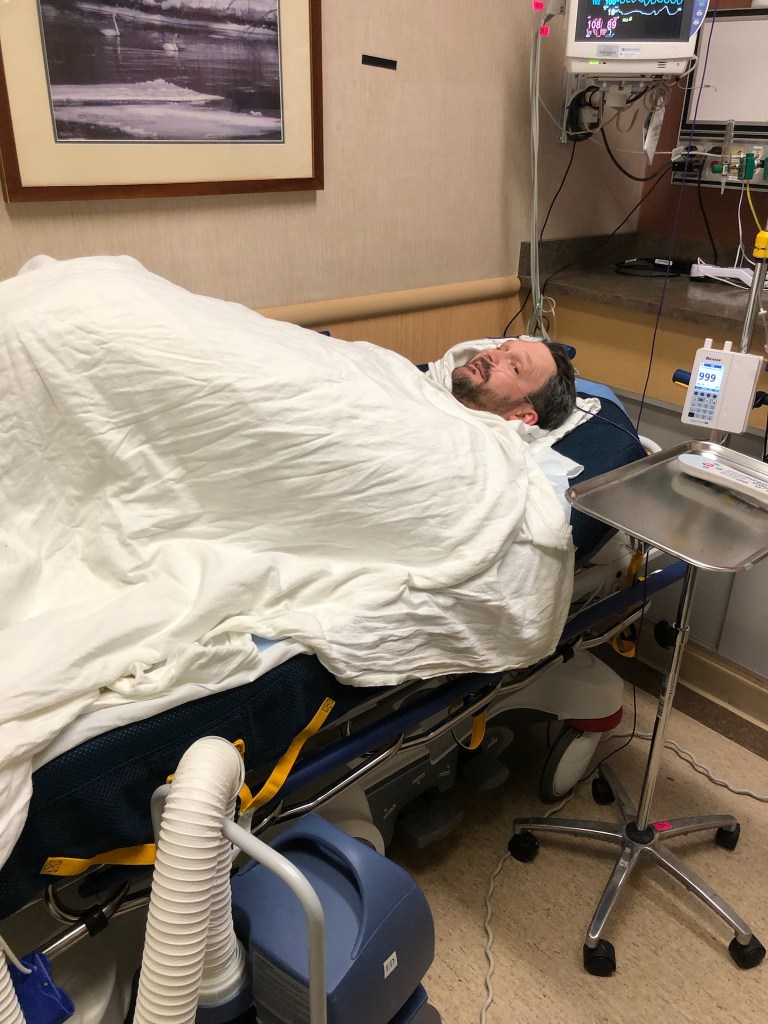
At 4:10 pm Nicole is shown into my room. We hug. She hands me my spare glasses. It’s a relief to see clearly again. Joy and grief bleed together. “Charlie didn’t make it,” she says. By the time he arrived at the vet, his heart had stopped. Attempts to resuscitate him were unsuccessful. Nicole’s dad would be collecting his body from the vet’s office. The news is heavy, but my own fight has left me strangely numb.
I learn that I’m in line for an overnight room. I’ll likely be waiting a few hours. Apparently the hospital is straining from an influx of covid patients. Harrowing sounds drift in from down the hall. An elderly man is gasping and sputtering for breath, as if his lungs were being scoured with broken glass. I assure my nurse that I am vaccinated. She is openly grateful, visibly relieved. “You have no idea how much simpler that makes everything,” she says.
At 9:30 pm I’m finally moved to my overnight room in the cardiac wing. I call Nicole from the room phone. She’s worried about my heart stopping during the night. I promise to call first thing in the morning.
I sleep in fits and starts. Nurses wake me at regular intervals during the night to check my vitals. Several times I roll my IV pole into the bathroom to relieve myself. For periods, I stare at the screen of the heart rate monitor, the green line fluttering upward with reassuring regularity. My mind grapples obsessively with the moment the canoe flipped. Precisely how had I messed up? How can I be certain never to repeat the same mistakes? And, why had I spent precious minutes unloading the patio fridge? Why hadn’t I gone for Charlie’s bowl sooner? Again and again, I see Charlie, struggling, whimpering. I had survived, but I had failed. My foundations had been shaken; my equanimity shattered. I knew I wouldn’t be able to rest again until I’d extracted and implemented whatever lessons were here to be learned.
At 5:22 am I call Nicole. She is relieved to hear my voice. It’s Christmas Eve. My hands and feet are variously tingling and numb, but otherwise I feel almost normal. “You’re probably going to feel like you ran a marathon,” my nurse says. But I am restless, eager to get home. The official bureaucracy grinds along indifferently. It’s 11:11 am by the time the doctors and nurses are done with me and my discharge papers are printed. My vitals are back to normal, blood tests all clear. Ten minutes later I walk out the door to Nicole, Ian and Teddy in the waiting car.
Time seems slower, precious, gilded. Our house appears enchanted through the trees as we roll down the driveway. I step into safe, familiar spaces, basking in the uncertain gift of getting to pass this way again. But no dog runs to greet me. A lump forms in my throat. I hold my boys—Ian, emotionally tenuous at the best of times from too many prior losses; Teddy, emotionally self-assured and doing his best to make sense of daddy’s 20-hour disappearance. “Is that your owie, Daddy? Is that why you were in the hospital?”, he asks, pointing at the bandaid where the IV needle had just been pulled from my wrist.
I measure out my coffee beans: 20 grams. I heat the water: 175 degrees. I drink in the aroma as perfect water combines with perfect grounds. The frother whirrs. A familiar ritual; a new beginning.
At 1:15 pm Nicole’s parents arrive. Her dad has come to help me bury Charlie. Nicole and I make our way to the detached shed. I carefully open the box and pull back the pink fleece blanket. There’s Charlie, curled up, perfect, for all the world, asleep. I place my hand on his cold, stiff body. I stroke his silky little head. My chest and throat are tight, but I feel numb. “I’m sorry, little buddy,” I whisper, “I’m so sorry.” Nicole crouches over Charlie. Her pain is raw; tears stream. I hold her.
Shovels in hand, Phil and I make our way into the woods behind the shed. The ground is insulated by thick leaf cover. We’re relieved to find it soft, unfrozen, easy to dig. We lay Charlie in the ground, still wrapped in the blanket, with his collar and name tag. Nicole watches as the pink bundle disappears beneath the black dirt. Several heavy minutes pass. Nicole’s parents leave.
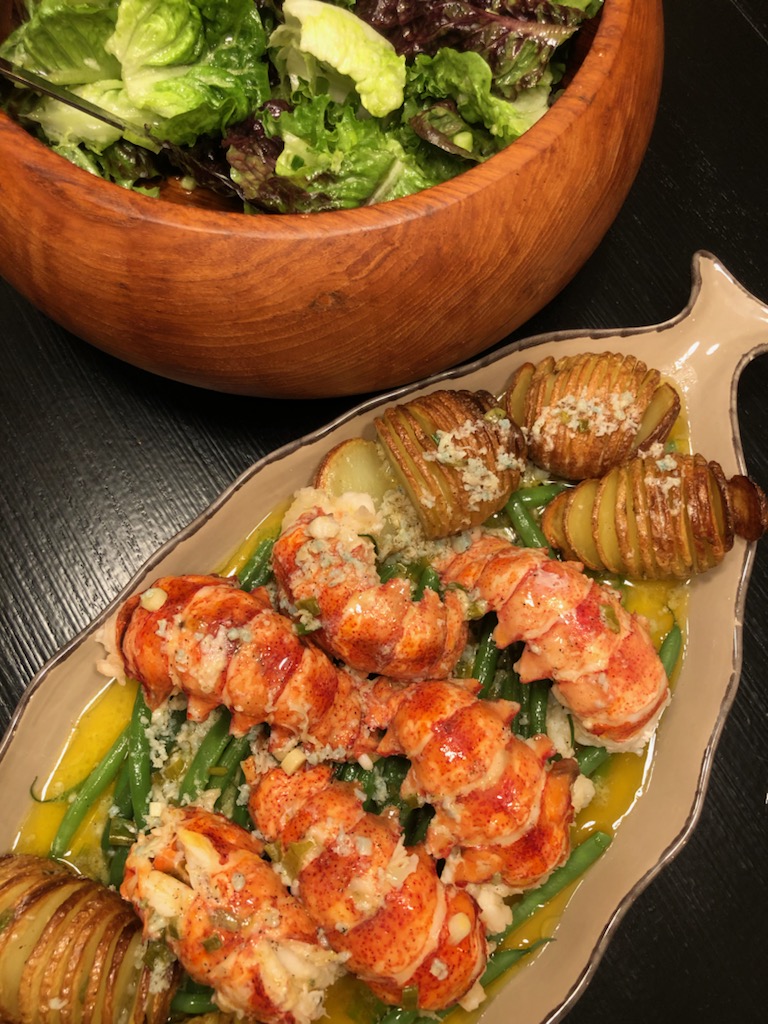
That evening I cook lobster tails in lemon garlic butter. Together in the living room, we each open one present. Our hearts are simultaneously full and broken.
Postmortem
So, what am I to make of these 24 brutal hours that, like a mythological monster, reared up unexpectedly from the deep to tear at my world? I’ve been pondering this question for almost six weeks now. In the final analysis, I see the numerous ways in which I failed and bear responsibility, as well as the fact that I did ultimately act when I could have shirked.
I bear the weight of having made the judgment call to move to a house on the water eight months prior. Like Icarus, had I tasted the fruit of hubristically biting off more than I could chew? Here I am genuinely unsure. This truly seems to be a question of balancing competing goods. Living small and avoiding risk does reduce one’s attack surface. It also limits, constrains, even stunts. Life stripped of real dangers and real responsibilities produces people devoid of meaningful resilience and true competence. I grant that each of us must be free to strike this balance for ourselves, but I think I will keep the dangers, opportunities and privileges of living more expansively, and seek to foster the attendant competence and responsibility. I trust that my boys will be better for it.
The next dimension of culpability is perhaps less obvious and more insidious. It is a dimension I have confronted in myself repeatedly, and one that I honestly fear I will be confronting to the end. I’m talking about allowing resentment to accumulate. In this instance, I had allowed an insidious ribbon of resentment to creep into my attitude toward Charlie’s intransigent temperament. Why else had I given up calling him in frustration? Why else had I delayed getting his bowl? Why else had I wasted precious minutes emptying out the patio fridge? Without constant vigilance and a willingness to call a spade a spade, resentment accumulates, gradually—it accumulates around relationships, around responsibilities, around the brute reality that the relentlessness of life is hard. Allowing the incremental accumulation of resentment is like playing Russian roulette with 999 of 1000 chambers empty. One day, the chamber is loaded. December 23, 2021, was such a day for me.
It is also not lost on me that, had I completed my fall tasks in their season, Charlie may still be alive today. How often is it that seemingly small past failures are in fact the but-for causes of far more consequential present catastrophes? I suspect far more frequently that we care to admit.
The fourth dimension of failure is obvious—the straightforward technical matter of having maneuvered the canoe ineptly when it mattered most. It is nested in the broader failure of having allowed the urgency of the situation to collapse the scope of my perception. Like the terrified naïve threatened at gunpoint, unable afterward to describe anything but the appearance of the end of the barrel, I was so focused on Charlie that I lost sight of the broader situation, I overlooked rudimentary aspects of safely handling my canoe. Knowing full well the potency of the special operations aphorism, “slow is smooth, smooth is fast,” and with non-trivial experience of performing under pressure, I still dropped the ball. I know better; I should have been able to execute.
Finally, there is a question of judgment. Some may reasonably ask, why did you risk your life, risk the integrity and stability of your family, for a dog? I have pondered this in depth. I suspect the answer lies in what I think of as the Raskolnikov dilemma. In Dostoyevsky’s 1866 novel Crime and Punishment, the main character Raskolnikov commits a rationally justifiable murder, only to discover that pre-murder Raskolnikov and post-murder Raskolnikov are not the same person. In other words, quite apart from the exterior objective outcome of action or inaction, there is an inner, characterological consequence to action or inaction. Yes, had I not acted, the outcome would arguably have been better: Charlie would still have died, but we’d have been spared my painful experience, my family’s trauma at almost losing me, my nerve damage, medical bills, and the loss of a treasured canoe, a new phone, a pair of glasses and a canoe paddle. But life is more than a consequentialist philosophy seminar. In the face of mortal danger, I acted, because there was some chance that I could have saved Charlie from a situation for which I was at least partially culpable. Had I shirked when the moment came, who would I be facing in the mirror today? Who would my family be facing?
Life is ultimately a moment by moment series of opportunities on binary axes: to rise to the magnitude of the challenge of existence or to be diminished by it; to make things better or worse; to show up or to avoid; to take responsibility or to shirk; to affirm life or sink into nihilism. In archetypal terms, to bend the arc of reality ever so slightly further in the direction of heaven or hell.
So, I emerge from this trial determined to be made more by it; to capitalize on the vectors along which my agency might be brought to bear to make things better; refocused on the fleeting preciousness of life, not a moment of which is to be wasted or wished away; determined to be stronger, fitter, more whole, more present, more prepared.
Charlie lived like every moment was the best moment ever. He brought so much joy. His death has left a painful hole. We miss him. We will honor him by remembering how much he loved life, and by passing along his final lesson to our boys: never, ever, venture out onto the river ice.
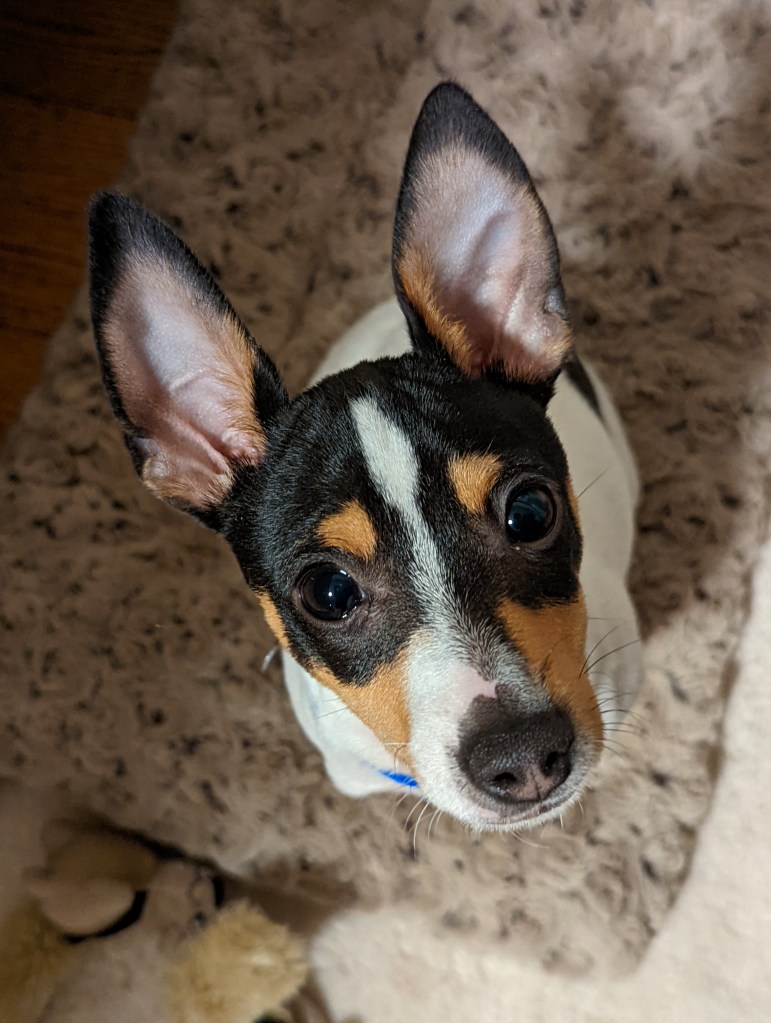
On January 10 we welcomed Bert Charlie Strydom, a sixteen-week-old toy fox terrier puppy—a celebration and affirmation of life, and a gesture to the future. May 2022 be a year of gratitude, growth, renewal, life, and of rising to the challenge.


I am sorry for the terrible ordeal you suffered, Hanno, and for the loss of your dog, Charlie. Your’s, is indeed, quite a story and so well written and presented. Have you ever considered writing as a profession? Life is so unpredictable and fickle; one minute triumph, the next tragedy. And we, seemingly, can do nothing about either.
LikeLike
I am truly moved to tears reading this poignant and introspective memoir. To write so eloquently about such a tragic and emotionally charged event is astounding. Charlie knows you were fighting for him, and he too fought the good fight to be with his beloved family again. I’m praying that those dragons you mentioned are in their respective caves. You didn’t shirk, you showed up in mighty form. I believe, on occasion, that the outcome of such an event has already been decided. And the executed tasks were part of a greater opportunity for digging deeper…. to ask not only the “what if’s” but more importantly, the “what now’s.” The latter is where the mind, body, and spirit reside in peaceful harmony, facing each new day bravely and confidently. Love 💕 to all of you.
LikeLike