
The Flood and the Ark
The first six installments (Part I, Part II, Part III, Part IV, Part V, Part VI) of this series traced the multi-millennial competition among monetary media, in which more integral monetary forms reliably displaced less integral ones with the impersonal consistency of water finding its level; examined how the gold standard was dismantled by political force rather than outcompeted, and at what compounding cost to every domain of civilizational life; showed that the deepest ideological debates of the modern era are conducted almost entirely within a shared fiat assumption that neither side examines, sustained by a vast self-reinforcing substructure whose members collectively ensure the continuation of an arrangement none of them explicitly designed; argued that the accumulated pressure behind the fiat dam is now visibly discharging, and traced what clear-eyed navigation of that transition might look like; introduced the axis mundi as an evaluative standard for monetary integrity, applied it to gold’s genuine achievements and its ultimately fatal structural weaknesses, and named the telecommunications rupture that made the fiat era not merely politically convenient but architecturally inevitable; and argued that Bitcoin’s proof-of-work architecture is the first monetary technology in history to credibly approach the triple-pole standard of maximal abstraction, maximal energetic grounding, and bearer-asset settlement at transactional speed. Part VI closed at the honest limit of what the monetary argument can carry: the analysis can identify a civilizational misorientation, but it cannot, from within its own frame, name what the misorientation is a departure from, or what it would mean to turn back toward it. This final installment follows the question one level further.
Follow a question far enough and it stops being the question you started with.
This series began as an inquiry into monetary mechanics — into the structural forces that have shaped civilizational outcomes with the impersonal regularity of water finding its level. That methodological choice was productive. It illuminated things the standard narratives of political failure and elite malfeasance consistently obscure. It revealed mechanisms that operate without anyone needing to understand or intend them, transferring wealth and corrupting incentive structures across generations, draining the future to service the present.
But followed to its honest limit, the inquiry broke through the floor of monetary analysis into something it did not set out to find.
The argument about what makes a monetary medium integral — the requirement that genuine excellence joins maximal abstraction to maximal energetic grounding, without remainder — turned out not to be an argument about money. It turned out to be an argument about the structure of reality itself: about the fact that things work or fail in proportion to their alignment with what is genuinely real, and that the chronic substitution of the managed representation for the thing it represents is not merely a monetary pathology. It is the characteristic failure mode of a civilization that has, over several centuries and with increasing confidence, convinced itself that sufficient intelligence, applied with sufficient will, can override the constraints that reality imposes.
McGilchrist, whose work the series introduced in Part V, traced the same arc from a different direction entirely — through the history of Western art, philosophy, science, and institutional life. What he described as the progressive usurpation of the master’s governance by the emissary — the displacement of comprehensive contact with living reality by the drive to decompose and control it — is visible in the monetary record as clearly as it is visible in the impoverishment of the built environment, the restructuring of the food supply around engineered yield rather than nourishment, the financing of wars their populations were never asked to pay for. The monetary evidence is not the cause. It is one expression, among many, of a single underlying condition: a civilization that has replaced the question, what is the world like, and what does that demand of me? with the question, what is the world made of, and how might I best arrange it to my own ends?
This is not, it turns out, a new condition. It is a recurring one. And the fact that it recurs is, properly understood, not the grim news it first appears to be. It is the beginning of better news.
Every serious human culture, prior to the modern West, understood reality to be fundamentally cyclical. Not cyclical in the trivial sense that seasons repeat — though they do, and the agricultural calendar built around that observation was among the most important technologies any civilization has ever possessed. Cyclical in the deeper sense: that civilizations themselves move in recognizable rhythms of emergence, fullness, departure from genuine order, accumulated weight, and correction — and that this rhythm, however costly its corrective phase, is the mechanism through which the ground is renewed. The Hindu yugas encode this at cosmological scale. Ecclesiastes encodes it in its most compressed and honest form: there is nothing new under the sun is not a counsel of despair but a sober empirical observation — that the pattern repeats because the human condition that drives it is constant, and no accumulation of technical sophistication has yet altered that condition at its root. The book of Judges runs seven complete iterations of the cycle through a single text with the consistency of a tide, as if to say: this is simply how things go, for a people in our condition, within time — and knowing that it goes this way is itself a form of orientation.
The convergence across traditions separated by vast distances and centuries is not coincidental. Each arrived at this observation independently, which is precisely what gives it evidential weight. A pattern recognized once might be cultural accident. A pattern recognized independently by the Hindu cosmological tradition, by Hebrew wisdom literature, by the Stoic account of cosmic conflagration and renewal, by the indigenous traditions that structured their ceremonial calendars around cycles of death and regeneration — that pattern is pointing at something real.
What the traditions converge on is this: there is an arc that communities reliably follow. A period of genuine contact with what is highest and most real — when the ordering principle is honored, when the hierarchy of value is observed, when discipline feels less like constraint than like participation in something that works — generates surplus, security, and accumulated capacity. And that surplus, reliably, creates the conditions under which the discipline that produced it begins to feel optional. The emissary’s voice grows more persuasive in proportion to how well the master’s governance has been functioning. This is not a moral failing peculiar to the corrupt or the weak. It is the structural engine of the cycle, driven from within by the tension present in every human person between the orientation that receives the gift as gift, and the orientation that mistakes it for a production.
The West’s specific departure from cyclical wisdom was not the departure itself — every tradition expected that — but the conviction that the departure had been superseded. The modern West is the first civilization to have built its foundational institutions on the premise that the corrective mechanism of reality does not exist: that the ascending arc can be extended indefinitely, that the constraints the cycle imposes are engineering problems awaiting cleverer solutions. Fiat money is that conviction expressed at the monetary base layer — the explicit ambition of modern central banking being precisely the abolition of the correction that every prior culture understood as the mechanism through which accumulated departure from genuine order is discharged. The fingers in the dam are, at this level of analysis, fingers in the wheel of reality itself.
But here is what every tradition that takes the cycle seriously also holds, and what the modern West’s anti-cyclical conviction has most thoroughly obscured: the correction is generative. Winter is not a failure of summer. It is the precondition of spring — the condition without which the ground cannot be renewed, the silence without which the new growth has nowhere to root. To face it with clear eyes — not denial, not catastrophism, but genuine acknowledgment of where things stand — is itself a form of wisdom. And it is a form of wisdom that the present moment is actively pressing upon more and more people who are paying even ordinary attention.
Most of the world’s wisdom traditions locate the apex of the hierarchy of value — the point toward which genuine orientation tends — as an impersonal ordering principle: dharmic order, the Tao, the logos, the structure of things as they are. Orient yourself toward it and flourish; depart from it and accumulate the weight of that departure. The prescription is clear and the diagnosis is sound. The question those traditions leave open — and it is the most consequential open question in the whole of human symbolic thought — is whether the apex is indifferent to whether you find it.
The tradition that follows this logic furthest takes one further step. It does not merely say that there is an apex toward which all genuine value orients, or that alignment with it is the condition of flourishing. It says that the apex is not indifferent — that the movement is not only from below upward, but also from above downward. And this changes not the cycle’s contents but what the cycle is inside of. The correction still comes. The winter is still real. But the promise is prior to the flood, not subsequent to it. It is not conditioned on the adequacy of those who receive it.
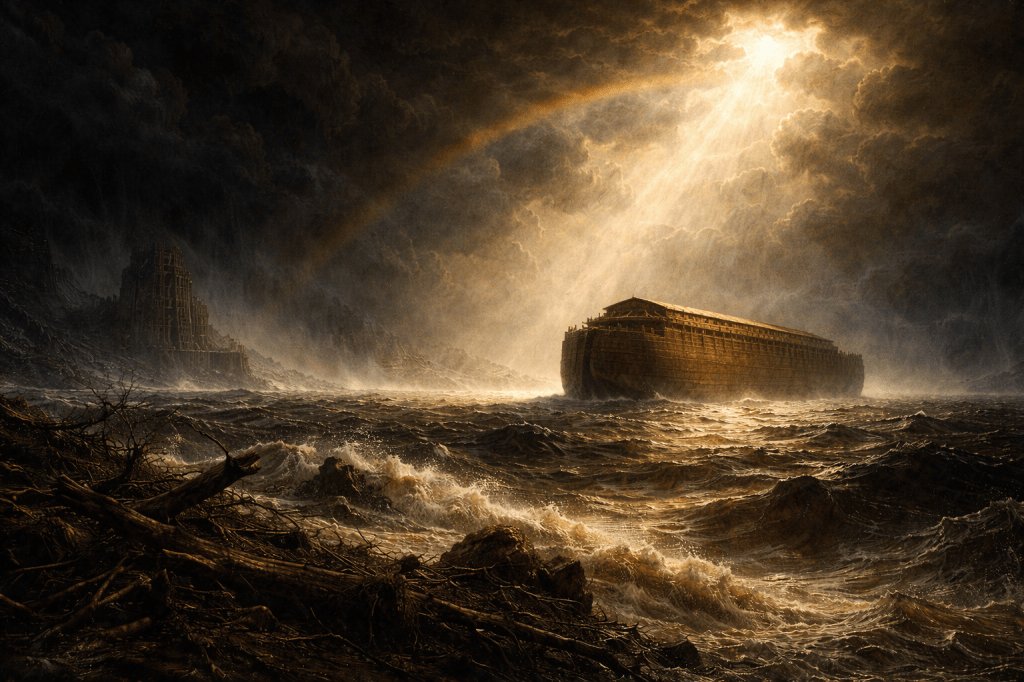
This is the insight carried in the image of the rainbow placed in the sky before the waters have fully receded, before the survivors have demonstrated anything, before the next departure has been forestalled. The covenant is not a reward for the ark’s seaworthiness. It is the ground within which the whole subsequent story unfolds — the assurance, given before every future failure, that the correction will not be final. That the New Ground will come. That the direction toward which proper orientation points is the direction toward what has already, from outside the cycle’s own resources, prevailed.
This is the deepest source of the hope the series can honestly point to. Not the hope that the transition will be comfortable, or that the right positioning will insulate anyone from difficulty. But the prior and more durable hope: that the structure of reality is not indifferent, that the direction of genuine value is oriented toward life rather than away from it, and that the people who have seen this clearly in every prior iteration of the cycle — the Ferrymen of their time — who built in advance, who provisioned for more than themselves, who held the covenant with more confidence than their circumstances strictly warranted — turned out to have been reading the situation correctly.
The traditions encoded this figure because they had observed it: the person in genuine contact with the underlying structure of reality, at precisely the moment when the false structures above are beginning to strain, whose seeing is already oriented toward doing, and whose doing is already shaped by what they have seen. Noah, in the narrative that gives this essay its image, is the Ferryman in his purest form — not waiting for instruction once the rain begins, but already in the build, already provisioning, already dimensioning the vessel for more than his own family’s survival, in the long stretch of apparently ordinary time before the sky broke. And the text is careful about the nature of his seeing: Noah does not arrive at his building through superior meteorological reasoning. He builds because he has sought and attended correctly to what is highest — and what is highest has spoken into that attention. The Ferryman’s clarity is not the product of better analysis. It is the fruit of a particular orientation — a particular kind of attention — rightly held.
The ranks of the Ferrymen are wider than they appear. They are not concentrated in any particular political tribe or intellectual tradition. They are, most of them, simply people who have followed a question far enough — about what is real, about what endures, about what their lives and stored energy are actually oriented toward — and who have allowed that question to reshape how they act. The farmer who returns to growing real food because he has recovered a sense of genuine stewardship rather than mere productivity. The builder who chooses permanence over depreciation because he understands that the built environment is a form of testimony. The parent who chooses depth over convenience in the formation of their children because they have glimpsed what is actually at stake. The person who holds sound money covenantally — as a form of integrity rather than a speculative position — because they understand what the alternative is doing to the civilization around them. These are not heroic figures. They are ordinary people who have allowed a genuine question to reach them, and who are building accordingly.
What the monetary argument opens, but cannot close, is the question the wisdom traditions have always been asking.
The preceding installments have addressed the instrumental question with appropriate care: what to hold, where to hold it, how to think about the transition. That question is genuine and the answers matter. But it is downstream of a prior question that no balance sheet can answer — a question about what you are actually oriented toward, what you treat as most real, what kind of attention you are bringing to your own life and to the lives of those around you.
There are two ways of attending to everything this series has argued. One reads it for conclusions: positions to take, assets to acquire, risks to hedge. That reading is not wrong, as far as it goes. But there is a second way of attending to the same material — a way that is less interested in what to do with it than in what it is pointing toward. This second mode of attention does not extract and file. It receives. It allows the pattern to disclose itself rather than demanding that it submit to a summary. It is the kind of attention that recognizes the cycle, not as a theory to be evaluated, but as a description of something already in motion — something one is already inside of, and which is already pressing its question.
That second kind of attention is itself the beginning of the reorientation the wisdom traditions describe. It is not something you perform. It is something you allow — a relaxation of the grip, a willingness to be addressed rather than merely informed, an openness to the possibility that the world is more than a system to be navigated and that your life is more than a portfolio to be optimized.
The monetary argument earned its conclusions through patient attention to the structure of what actually happened, and to what that structure keeps producing. The same patience, brought to the question of what you are made for and what you are oriented toward, tends to arrive at the same kind of clarity — and at the same discovery that the ground is more solid than the false structures above it have made it appear.
The flood is not the last word. The covenant precedes it. And the axis that stands when the waters recede has been there all along, waiting — not for the right institutional arrangement, but for the right kind of attention.


