
On the Fragility of the Sacred Commons Without the Sacred
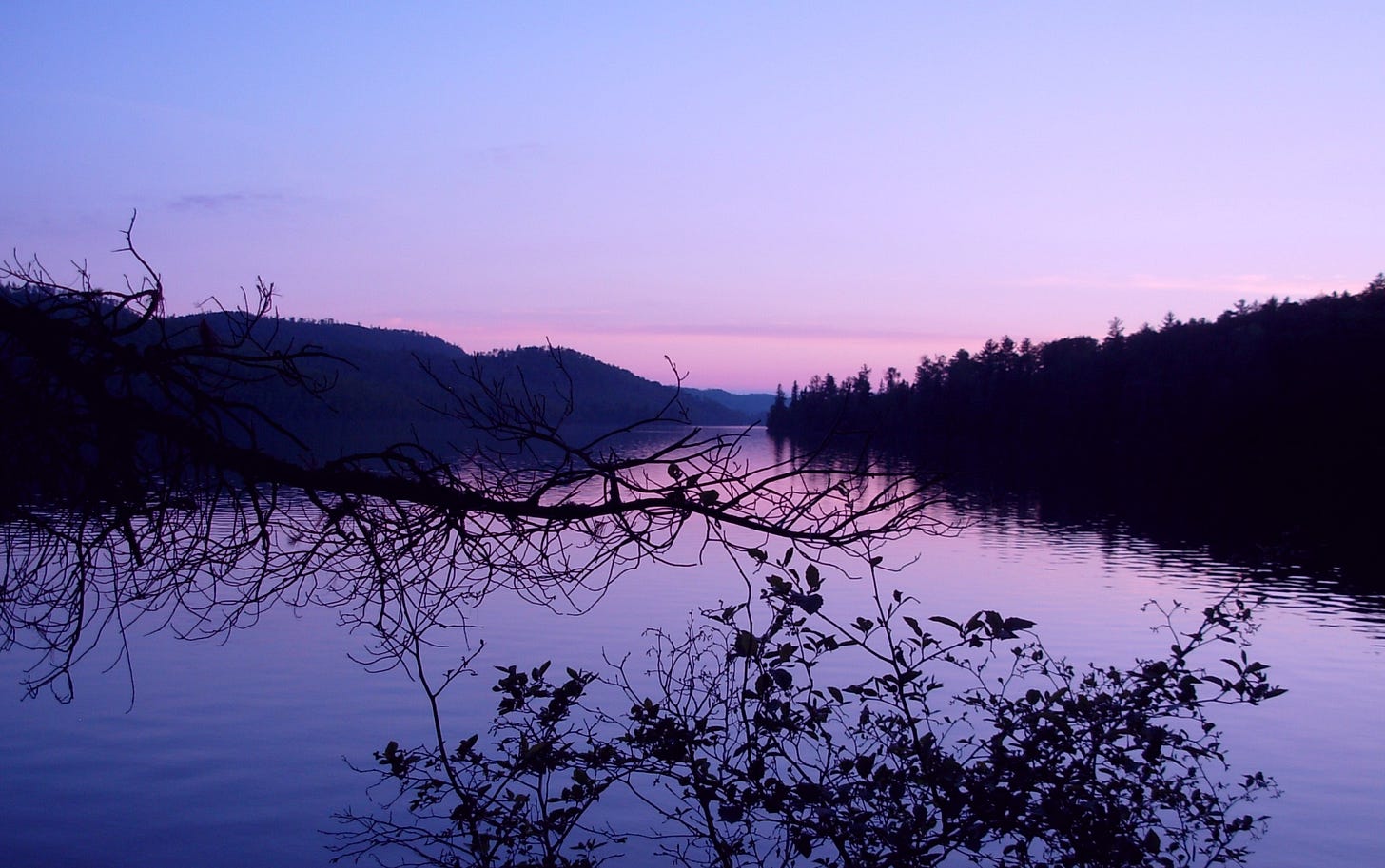
Sunset in the Boundary Waters Canoe Area Wilderness,
photographed by the author in June 2011
THE JUXTAPOSITION
On the morning of April 15, 2026, I harvested my fourth wild turkey on public land barely fifteen minutes from my home in Minnesota’s Twin Cities metro. It has become, for me, an annual ritual. Not recreation in the thin modern sense. Certainly not conquest. Something closer to embodied participation in the real. To move through that country in season, under law, with skill, patience, and restraint; to shepherd from field to table wild food of the highest quality; is to take one’s place within a pattern of life I did not invent and cannot enlarge. It is to receive a commons from within — to be formed by it, rather than merely to pass through it.
The next day, the United States Senate voted 50–49 to strip federal protections from 225,504 acres of the Superior National Forest in northern Minnesota. The headline acreage understates the scale. Those acres sit at the headwaters of the Rainy River watershed — nearly two million acres of lakes, wetlands, and boreal forest that drain northward through the 1.1-million-acre Boundary Waters Canoe Area Wilderness, on through Voyageurs National Park, and across the international border into Canada. Sulfide-ore copper mining carries a well-documented risk of acid mine drainage — sulfuric acid and leached heavy metals — whose effects do not remain inside the leased area. They travel with the water. I have bathed in this water. I have drunk from it. I have eaten fish from it.
The resolution, House Joint Resolution 140, used the Congressional Review Act to nullify Public Land Order 7917 — the 2023 mineral withdrawal that had sought to protect the Rainy River watershed for twenty years, after a Forest Service environmental analysis that drew roughly 675,000 public comments, more than ninety-five percent of them — including mine — in favor of protection. The Congressional Review Act mechanism also forbids any future administration from issuing a “substantially similar” rule without fresh congressional authorization. The withdrawal was not merely paused. By design, it became difficult to restore.
One day I was participating in one of the most extraordinary features of American life. The next day I was watching it be withdrawn.
I cannot let go of the juxtaposition. I do not think I am supposed to.
AN IMMIGRANT’S INHERITANCE
As an immigrant, I have never been able to experience American public lands as ordinary. In the country that formed me — Ireland — land of this kind, held on this scale, open on these terms, is inconceivable. There are forests and hills, and there is real beauty, and there are places one can walk. But the structure of access is different. Hunting and fishing are limited, often expensive, mediated by permit, lease, private permission, or the lottery of connection.
I did not know, until I came here, that a country could be organized so differently. I did not know that an ordinary citizen, without rank or money or the right relatives, could put a canoe on a lake that belonged to no one in particular and therefore belonged, in a quiet and actual sense, to him. I did not know that a forest could be entered without asking. I did not know that wildlife — elk, deer, ducks, walleyes, wild turkeys — could be understood not as the property of whichever landowner happened to hold title to the ground beneath them, but as a public trust, held in common for the use and benefit of all.
This is one of the stranger and more beautiful features of the American settlement. Under what came to be called the North American Model of Wildlife Conservation, wildlife is not an appendage of private title. It is not the king’s, and it is not the squire’s, and it is not — in the relevant sense — anyone’s. It is held in trust. The landowner does not own the grouse that walks across his field. The public does, collectively, and the state holds the trust to steward that renewable resource on the public’s behalf.
Valerius Geist, with Shane Mahoney and John Organ, set out the principles of that arrangement in what came to be called the Seven Sisters of conservation: wildlife is a public trust resource; markets in wild game are prohibited; access is allocated by democratic rule of law; hunting opportunity belongs to all, not merely to a class; wildlife may be taken only for legitimate use; migratory wildlife is an international resource; and management must be grounded in science.
That list is not a collection of ordinary regulations. It is the institutional form of a civilizational refusal. Each principle rejects some default most societies have accepted: private ownership of wildlife, commodification of game, access by rank, killing for frivolity, management by whim. The Model is an extraordinary inheritance, and one I suspect far too few Americans fully appreciate precisely because they received it by birth. Perhaps it takes an immigrant — a citizen by choice and not by birth — to grasp what we stand to lose.
It is perhaps no accident that Geist himself was an outsider: born in Soviet Ukraine, raised in Austria and Germany under the shadow of totalitarian regimes, and emigrated to Canada as a teenager. He did not invent the North American Model. He named it. But perhaps one had to come from elsewhere, from systems this continent had declined to reproduce, to see what was here clearly enough to say it plainly.
THE MEMORY OF ENCLOSURE
This inheritance did not arise from nowhere. It was, in part, a deliberate negation of a pattern many who came here had known first-hand, or whose memory they had received from parents and grandparents.
Between roughly 1450 and the early 1600s, and then again more aggressively in the centuries that followed, the English countryside was subjected to enclosure. Open fields were consolidated. Commons on which ordinary people had grazed livestock, gathered firewood, gleaned grain, and cut peat — in some cases for the better part of a millennium — were fenced and hedged and closed. Tenants were expelled. Rights were extinguished. Cottages were pulled down. By the time parliamentary enclosure consolidated the process in the eighteenth and nineteenth centuries, the medieval commons of England was substantially gone, and with it the material basis of a whole rural pattern of life.
The people displaced by enclosure did not vanish. Some joined the swelling ranks of the urban poor. Others crossed the Atlantic. The colonization of Virginia, Maryland, and New England was populated in no small part by the losers of enclosure — people for whom “common land” was not an abstraction but a recent wound. They brought with them an inherited suspicion of concentrated landownership, a memory of what it meant to be fenced out of what had been yours, and a hope — not always honored, but real — that in the new country the pattern could be different.
This helps explain why the early American political imagination was so marked by hostility to hereditary aristocracy and by the conviction that broad access to land was the material basis of republican liberty. Hunting came to function in the American self-understanding not as an aristocratic rite but as a democratic one: an emblem of the ordinary citizen’s place in a country that was not supposed to reproduce the old world’s concentration of land, game, and arms in the hands of lords.
One has to hold this honestly. The American commons of public land and public-trust wildlife was not extended to everyone. The 1854 cession of Lake Superior Chippewa territory, which the 2023 mineral withdrawal specifically named among the interests being protected, is itself a reminder that this commons was also established through Indigenous dispossession, and that its integrity is inseparable from the continued recognition of Indigenous rights within it. A serious defense of American public lands has to say this plainly. A commons that forgets who was displaced to make it cannot understand what it is, and cannot protect itself.
Still, with those complications acknowledged, something real was achieved and something real has endured. A man can still leave his house in the Twin Cities metro and, fifteen minutes later, be on public land with a shotgun and a turkey tag and a pattern of life his country still honors. That is remarkable. It is not normal in world history, and it remains inaccessible across much of the world today.
Which is why the Senate vote feels like more than a regulatory reversal.
I have been to the Boundary Waters. I have felt the haunting stillness of that country: the silence of boreal lakes, the sound of a paddle meeting water no engine has touched, the sense that one has entered not merely a scenic resource but a place that still resists being reduced to inventory. One does not go there and come back unchanged. The Boundary Waters are not a product. They are an inheritance. And an inheritance makes a claim on its heirs.
LIBERALISM’S FORGOTTEN PREMISE
There is a tension in defending the commons within the American tradition, and the argument cannot skirt it. The liberal inheritance that formed this country — Locke, the common law, the Declaration, the colonial memory of state overreach — begins with the sovereign individual. Property is not merely a social grant. It is the extension of the self into the world, a natural right that precedes the political compact and that the compact exists, in part, to protect. “Don’t tread on me” is not merely an attitude. It is the compressed form of a serious philosophical claim.
On this account, the commons is always somewhat suspect. A commons is a collective claim on the individual, a constraint imposed by something the self did not choose and cannot easily exit. The regulatory state that manages public lands can become — and in the lived experience of many rural Americans often has become — the instrument by which distant authorities dictate what a person may do with the ground beneath his feet, the water crossing his property, or the wildlife crossing his fence line. The deep American suspicion of this is not simply selfishness dressed up as ideology. It reflects a real historical memory of what happens when collective authority goes unchecked.
But here is what the tradition has forgotten about itself: the individual sovereignty Locke articulated and the Declaration enshrined was not, in its original form, self-grounding. “Endowed by their Creator” is not a rhetorical flourish. It is the load-bearing premise. Rights are unalienable precisely because they are not issued by the political compact and cannot be recalled by it. They are received, not generated. And a right that is received rather than generated is held under terms.
Among those terms were obligations. The sovereign individual, in Locke, is not an island. He is a creature of natural law — an order he did not author, embedded in a creation he did not make, under a governing principle that both grants and constrains. His property right is real, but it is bounded by the same natural law that grounds it. The received sovereign is always also a custodian.
Remove the vertical reference, and the tradition falls apart against itself. Unmoored from the source that originally grounded and constrained it, individual sovereignty becomes pure will against all constraint, appetite without obligation, property right without stewardship duty. And the paradox is that unmoored individual sovereignty does not protect the commons. It becomes the instrument of enclosure. A mining conglomerate can exercise the same logic of sovereign property right the “don’t tread on me” tradition prizes: it has a lease; the lease is its property; it will do with its property what it judges best for its shareholders. No court of appeal above current interest can tell it otherwise.
The individual sovereignty that was supposed to stand against concentrated power becomes, in its unmoored form, the philosophical license by which concentrated power proceeds. The tradition is turned against the inheritance it was meant to protect.
What the commons requires is not the abolition of individual rights but their recovery at a deeper level: not the unmoored sovereign individual standing over against the living whole, but the embedded sovereign person standing within it. The embedded sovereign person is genuinely free, capable of resistance to illegitimate authority, entitled to say “don’t tread on me” to any human power that overreaches. But he holds that sovereignty as received rather than self-generated. He understands himself as embedded in a living order he did not author and cannot dissolve by preference. He is answerable to a highest governing principle that both liberates him from human tyranny and constrains him toward the commons, the unborn, the downstream watershed, and the treaty partner across the century.
This is the anthropology the commons requires, and it is the anthropology the commons and the liberal tradition once shared. We did not lose the commons and the tradition separately. We lost them together, by the same forgetting.
THE LIMITS OF A HORIZONTAL DEFENSE
That is not primarily how the 2023 protections were defended, and given the grammar available to us now, it is not really how they could have been defended. The withdrawal rested on watershed integrity, wilderness character, outdoor recreation economics, tribal treaty rights, and the adverse environmental consequences of sulfide-ore mining. All of it was true. All of it was well-documented. Ninety-five percent of public comments agreed. And none of it was enough — because all of it was horizontal.
By horizontal I mean framed at the same level as the thing it opposes. A watershed is a good. A mine is a good. A recreation economy is a good. Critical minerals for national security are a good. Tribal treaty resources are a good. Jobs in the Iron Range are a good. In a flat moral order, these are competing claims on the same plane, subject to cost-benefit analysis and adjudicated by whichever coalition holds the necessary votes this season. In 2023, one coalition weighed them one way. In 2026, another coalition weighed them differently. That is not the system malfunctioning. That is the system working as designed.
What the horizontal defense cannot do is what only a covenant can do: invoke a claim that neither party authored, and therefore neither party may revise. A contract between A and B is terminable when A or B no longer finds it advantageous. A covenant made before a third party — a witness, a sovereign, a name — is not terminable on those grounds, because the terms were not set by A and B alone.
The 1854 treaty that ceded this territory is, structurally, a covenant: it was made before witnesses, bound parties not yet born, and imposed obligations not conceived as renegotiable whenever the balance of interest shifted. The Congressional Review Act that nullified the protections built in part on that treaty is, structurally, a contract: it expresses the current majority’s assessment of current interests. That these two logics collided on the same watershed, and that contract logic won, is not incidental. It is the demonstration.
What is happening, in its structure, is enclosure. Not strips of common field converted to sheep pasture for a lord, but a watershed converted to mineral lease for a mining conglomerate. Different century, different commodity, different mechanism. Same pattern: a commons held loosely within a moral order that lacks any authority higher than current interest is reorganized in favor of the interest strong enough to do the reorganizing.
This is the quiet scandal of the modern commons: we have inherited it, but not the ontological orientation or the language required to defend it. We enjoy its fruits. We do not possess the worldview by which an earlier civilization could say, this must not be touched, and mean it, and have the meaning hold.
THE SACRED COMMONS
What once held a commons in place was not the unstable balance of private appetite against collective power. It was the authority of something above both — something neither side authored and neither side could legitimately revise. The land was not first ours to divide, monetize, or administratively rebalance. It was given. “The earth is the Lord’s, and the fullness thereof” was not a pious caption attached to an economic arrangement. It was the structural reason the arrangement could bind.
This is the distinction between the commons and the sacred commons. The commons is a horizontal arrangement: shared use, customary rights, mutual obligation, the kind of thing that can be negotiated and revised among the parties to it. The sacred commons is the same arrangement held under a vertical claim — under a title neither the individuals nor the collective generated and neither has standing to revoke. The two look identical in good weather. They diverge under stress. Under stress, the merely horizontal commons reveals itself as an agreement among the strong to honor the customs of the weak for as long as honoring them remains agreeable. The sacred commons reveals itself as a trust held by the present generation under a title above all generations, which it does not own and cannot legitimately liquidate.
Remove the vertical reference and the commons does not become more secure by being secularized. It becomes metaphysically homeless.
This is why the market cannot finally save the commons. The market asks what quantity of abstract financial tokens the commons can be converted into, and a commons submitted to that question has already lost the argument. The North American Model understood this with wildlife: it erected a categorical prohibition on the commercial trade in wild game because it recognized that once a living creature enters the logic of exchange, it is worth more dead than alive. The question is whether we can recover an equivalent conviction for the land itself — not by forbidding all use, but by distinguishing between a commons that may be utilized in perpetuity and a commons that may be consumed. A grazing lease does not remove the land from the commons. A sulfide mine at the headwaters of a wilderness watershed risks destroying the interconnected system that makes the commons what it is.
Nor can the state finally save the commons by itself. Not because states are uniquely corrupt, but because in the absence of a higher limit the state eventually asks only what it is permitted to authorize. In a horizontal polity, the answer is shaped by whoever stands to gain the most from the authorization. The democratic version of this failure diffuses responsibility through procedure until no one in particular is to blame. A 50–49 vote against the expressed preferences of more than 640,000 citizens can liquidate a watershed in the name of those citizens themselves, with procedural legitimacy and no individual culpable enough to be remembered.
The horizontally oriented market devours by price. The horizontally oriented state devours by procedure. In the absence of anything above either, they meet in the middle and trade: the state authorizes, the market commodifies, and what had been held in common is reduced, once again, to what can be bought.
This is not an argument that only believers can love a watershed, nor that any particular religious settlement can be imposed as public policy. It is a structural observation about what holds a commitment in place when the parties to it find the commitment inconvenient. A contract held only by the parties who signed it is renegotiable the moment they prefer to renegotiate. A covenant held under a witness that stands above both parties is not, because the terms are not theirs to revise. What the commons requires is such a transcendent witness: a claim authoritative enough to say to the current majority, this is not yours to dispose of.
Whether that authority must finally be theological is a question this essay does not presume to fully close, though I suspect the answer is no less demanding than that. Covenants do not permit the parties to have their cake and eat it too: one cannot receive the rights and privileges of a sacred trust while refusing its limits, constraints, and responsibilities. Either the obligation stands under an authority higher than the parties themselves, or it remains, in the end, a contract waiting for sufficient convenience to undo it.
THE FORMATION ECONOMY
There is a deeper failure beneath the structural one. For several centuries, our civilization has been dismantling what I have come to understand as the formation economy: the dense ecology of practices, institutions, liturgies, rites, apprenticeships, disciplines, and sustained participations by which human beings were once formed into creatures capable of perceiving goods that cannot be reduced to interest.
Monasteries. Guilds. Parish life. The agricultural year. Fast and feast. The sacraments. The mentoring of trades. Family as covenantal commitment. Fixed-hour prayer, manual competence, communal obligation, the patient inhabitation of a landscape across generations. None of these were perfect. Many were abused. But together they did something no argument can do: they formed people. They formed them into beings whose faculties could register — in the way a trained ear registers a chord — the difference between what may be traded and what must not.
That economy has been unmade by roughly the same pattern, and for roughly the same reasons, as the physical commons. Formational institutions and formational lands were dismantled together, part of a single civilizational process by which we learned, in both domains at once, to see everything as alienable. The watershed we are now poised to mine is the downstream consequence of these deeper developments.
Iain McGilchrist’s work helps name the same dismantling at the level of attention. The right hemisphere apprehends the world as relational, contextual, value-laden, and alive — a living whole within which the perceiver participates. The left hemisphere apprehends the world as a collection of abstracted, manipulable parts — an inventory available for use. Both are necessary. The catastrophe is not that we have a left hemisphere. It is that the inventory-making mode has progressively usurped the integrating mode. The map has mistaken itself for the territory.
The collapse of the formation economy and the ascendancy of this restricted attention are not two separate stories. They are one story told in two registers. The formation economy was, among other things, a civilizational training in participatory attention: the liturgical year, the sacrament, the icon, the apprenticed trade, the patient inhabitation of a landscape, the communal rhythms that placed the self inside a living whole it had not authored. Dismantle that economy, and you do not produce a neutral person. You produce a person exquisitely capable within the frame, but increasingly unable to perceive that the frame is not the whole.
This is what the 50–49 vote revealed. Not merely the malevolence of fifty senators, and not merely the pressure of a foreign mining interest, though both may be operative. It revealed the metaphysical geometry of a flat polity and the anthropology that geometry produces. Those formed chiefly for the calculation of interest, the management of tradeoffs, and the procedural balancing of claims may be capable of asking what a watershed is worth. They are no longer reliably capable of asking what a watershed is.
I too am susceptible to the same corruption. This is not a failure located in one party or one committee. It is a civilizational condition in which we are all steeped. Even those of us who fought for the Boundary Waters often did so in the only register we still possess: the register of use, impact, economics, procedure, and preference. We were expressing a residual perception — a kind of phantom limb — of a faculty whose formative conditions we have nearly finished dismantling.
We still inhabit the commons. We no longer know, with sufficient authority, how to justify one.
I do not say this in despair, and I do not say it to indict those who fought for the Boundary Waters. The citizens who spoke up, the staffers who ran the Forest Service analysis, the lawyers, the conservation advocates, the senators who stood on the floor and pleaded — all of them did what could be done with the tools a horizontal order leaves available. That is not a small thing. It is simply not, by itself, a sufficient thing.
The morning of April 15 and the afternoon of April 16 belong to the same story. On one side: lived participation in an inheritance older than any of us, richer than any account we can give of it, astonishingly rare by the standards of human history. On the other side: a procedural fragility so complete that the protection of the Rainy River watershed turned on whether one additional senator could be persuaded to cross the aisle and whether a particular legislative mechanism did or did not apply.
The inheritance is still close enough to touch. A man can still leave his house in the Twin Cities metro and, fifteen minutes later, be on public land with a shotgun and a turkey tag and a pattern of life his country, for now, still permits and even honors. That is not nothing. It is a great deal. But it is provisional in a way that a sacred commons was not, and what is provisional can be withdrawn. By vote. By procedure. By the sort of afternoon in Washington that most of the country will have forgotten by next spring.
I love American public lands not because they are efficient, and not because they are administratively interesting, and not only because they are beautiful. I love them because they are one of the few remaining signs, in modern political form, that a people can still understand some goods as held in common — not divided, not monetized, not enclosed, not reduced to whoever’s turn it is at the lever. As an immigrant from a predominantly enclosed land, I know how precious that is. And precisely because it is so precious, I am convinced it cannot survive indefinitely on sentiment.
What is sacred may be stewarded badly. But what is not sacred will, sooner or later, be liquidated.
THE ONLY RECOVERY THAT COULD WORK
The deepest temptation is to imagine that the cure is merely theological in the propositional sense — that if we could restore to public life the conviction that creation is gift, the institutions of the commons would naturally follow. But doctrine alone does not produce the steward. The steward is the long, patient, mostly invisible product of an entire ecology of practices.
Nor, however, are human witnesses adequate in themselves. A covenant does not endure because well-formed people stand in the place of the sacred. It endures because the sacred is real, because there is a Sovereign before whom the parties stand, and because a people has been formed deeply enough to recognize that sovereignty, receive its gifts, and accept its limits. Formation does not create the authority. It makes human beings capable of perceiving and obeying it.
The liturgical calendar, the sacrament, the apprenticed trade, the intergenerational inhabitation of a landscape — these do not replace the sacred witness. They orient a people toward Him. They train attention, desire, and imagination until the commons can be seen not merely as useful, public, or beautiful, but as received: a trust given under judgment, carrying rights and privileges inseparable from limits, constraints, and responsibilities.
Without that vertical reality, and without a population formed to live under it, covenant collapses back into contract. The commons becomes renegotiable whenever the witness is forgotten, whenever the generation changes, whenever the current majority finds the obligation inconvenient. The recovery the Boundary Waters requires — and that every commons in a flat polity requires — is therefore not finally the recovery of the right policy, nor even of better moral sentiment. It is the recovery of sacred sovereignty, and of people formed to inhabit the world beneath it.
Unless we recover a language — and the formation that makes such language speakable and hearable — in which the commons is not merely useful but given, not merely public but entrusted, not merely beloved but sacred, we will go on admiring these places while losing them, one reversible protection at a time. Every wilderness will live by permission. Every commons we love will stand one vote away from liquidation. And the pattern that drove our ancestors across an ocean will continue to work itself out on this side of it, in new forms, under new names, with the same result.

 Deliberative Dad